Trenchless pipe repair is often sold as a magical, no-mess solution, but that’s not the whole story. Many homeowners ask: “Is trenchless pipe repair really worth the higher price?” The confusion comes from marketing hype and a lack of clear guidance.
While it’s an incredible technology for saving your landscaping, it has serious limitations that contractors don't always rush to tell you about. This guide reveals the truth about trenchless pipe repair that most homeowners don’t hear, helping you make a decision based on facts, not just a sales pitch.
What Contractors Don’t Always Tell You About Trenchless Repair
Everyone in Sonoma County loves the idea of fixing a busted sewer line without turning their yard into a construction site. Trenchless pipe repair sounds like the perfect answer, right? In many cases, it is.
But this "no-dig" approach comes with trade-offs that are rarely discussed upfront. Understanding these hidden truths is the key to making a smart, long-term decision for your property.
The Hidden Costs of Convenience
While trenchless methods can reduce surface damage, that convenience comes at a price. The specialized gear required for trenchless repair—like cured-in-place pipe (CIPP) liners—can drive up the initial cost significantly.
For a typical home in Sonoma County or along the Central Coast, that "no-dig" promise can mean a final bill that's 20-50% higher than traditional excavation, especially for smaller jobs under 100 feet. The trenchless relining market is projected to reach $8.4 billion by 2030 because it offers lower surface disruption and faster turnaround Fortune Business Insights.
It’s Not a Cure for Every Problem
Here’s the biggest secret: trenchless technology is only as good as the pipe it’s trying to fix. The success of a trenchless repair depends almost entirely on the structural integrity of the existing "host" pipe.
You can’t put a new coat of paint on a crumbling wall and expect it to be strong. The same logic applies here. Failure rates increase if the pipe has significant root infiltration, a poor slope, or structural collapse.
Consider these critical deal-breakers:
- Completely Collapsed Pipes: If a section of your sewer line has already caved in, a liner can't magically jump the gap.
- Severe Sags or "Bellies": A liner will just follow the sag, meaning you’ll still have a low spot in your pipe where waste and water will pool.
- Major Offsets or Breaks: If the pipe sections are badly misaligned, the liner or bursting head simply can't get through.
To help you find the right pro, we put together an ultimate excavating contractor checklist with key questions to ask before you hire anyone.
Trenchless vs Traditional Repair At A Glance
This table gives you a clear, side-by-side look at the key differences between trenchless and traditional excavation, helping you quickly understand the trade-offs.
| Factor | Trenchless Repair | Traditional Excavation |
|---|---|---|
| Yard Disruption | Minimal. Only small access points are needed at each end. | Significant. A long, deep trench is dug along the pipe's path. |
| Upfront Cost | Higher. Typically 20-50% more for smaller residential jobs. | Lower. Often the more budget-friendly option upfront. |
| Project Time | Fast. Usually completed in 1-2 days. | Slower. Can take several days to over a week, plus landscaping repair. |
| Best For | Pipes with cracks, leaks, or root intrusion that are still structurally sound. | Collapsed pipes, severe sags, major offsets, or when full replacement is needed. |
| Landscaping Impact | Low. Preserves lawns, driveways, patios, and mature trees. | High. Requires complete restoration of landscaping and hardscaping. |
| Pipe Condition | Requires a "host pipe" that is mostly intact to work properly. | Works regardless of the old pipe's condition, as it's fully removed. |
Ultimately, the right choice depends entirely on your specific situation—the condition of your pipe, your property layout, and your budget.
How Trenchless Technology Actually Works Underground
To get to the truth about trenchless pipe repair, you first need to understand what’s actually happening underneath your yard. It’s a clever feat of engineering that uses small access points to perform complex repairs entirely underground.
There are two main methods you'll run into, and each takes a completely different approach.
Cured-In-Place Pipe (CIPP) Lining
The most common method is Cured-In-Place Pipe (CIPP) lining. A flexible, felt liner is saturated with epoxy resin and inserted into your damaged pipe.
An inflatable bladder is pushed through, pressing the liner against the walls of the old pipe. Hot water or steam cures the resin, hardening it into a brand-new, seamless pipe inside the old one.
It’s an incredibly effective fix for pipes that are still mostly intact but have leaks or cracks.
The infographic below helps visualize the journey from the promise of a perfect lawn to the important truths you need to consider.
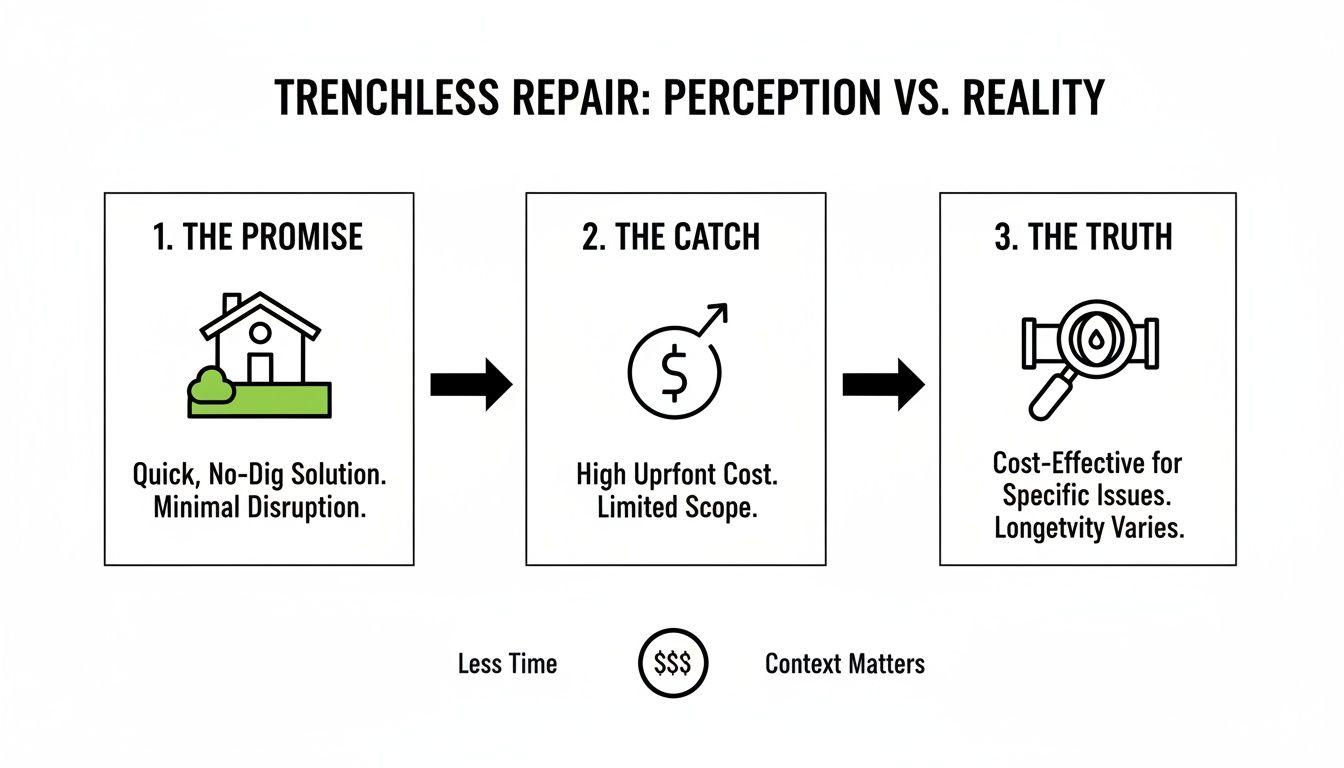
As you can see, while trenchless repair saves your yard, its success depends entirely on a thorough, honest evaluation of your existing pipes before any work starts.
Pipe Bursting
The second method is called pipe bursting, a much more aggressive technique. This is the go-to when the old pipe is too collapsed or damaged for lining.
A heavy, cone-shaped "bursting head" is pulled through the old pipe, shattering it outward into the soil. Right behind it, a brand-new, high-density polyethylene (HDPE) pipe is pulled into its place.
This is one of the many specialized underground utility services that requires serious equipment and expertise to pull off correctly.
The Critical First Step: Neither of these methods should ever begin without a comprehensive video camera inspection. This step is non-negotiable.
Hidden Deal Breakers That Cause Trenchless Repairs To Fail
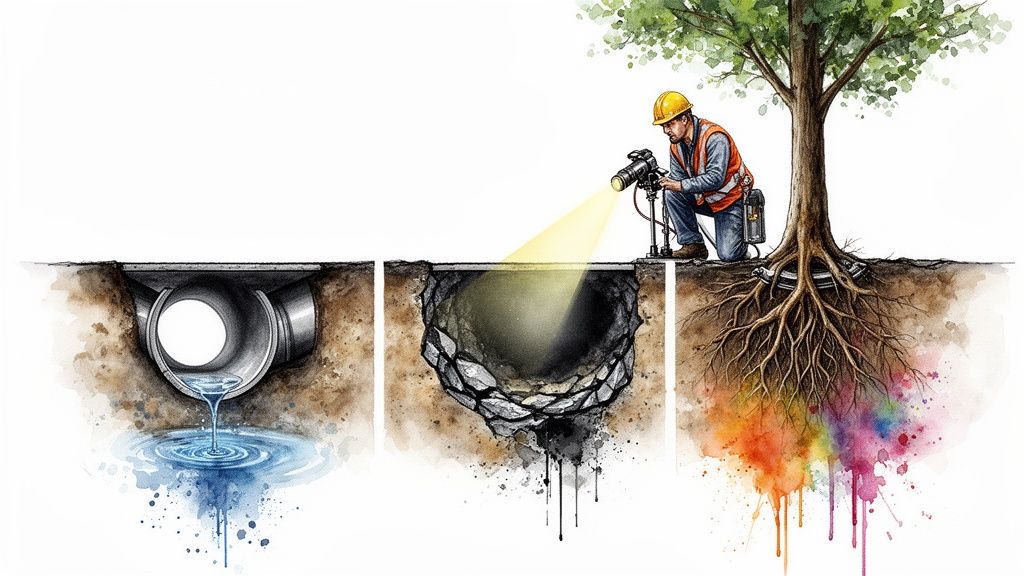
This is the hard truth that most homeowners don't hear: trenchless methods are not a universal fix. Forcing a trenchless solution onto the wrong problem is a recipe for expensive headaches.
The success of any trenchless repair depends entirely on the condition of the existing pipe. If the "host" pipe is in bad shape, certain issues are absolute deal-breakers.
When Trenchless Repair Is The Wrong Choice
An honest contractor will tell you when a camera inspection reveals problems that disqualify your pipes from a no-dig solution. This is especially critical in older California neighborhoods where pipe materials and soil conditions are a factor.
Here are the specific red flags that make trenchless methods a bad investment:
- Severely Collapsed Sections: If part of your pipe has caved in, there's no "host" for a new liner to follow.
- 'Bellied' or Sagging Pipes: A flexible liner will just conform to that sag, creating a permanent low point where water and waste collect.
- Heavily Offset Joints: In areas with active soils like Monterey County, old pipe joints can shift and become badly misaligned. A liner can't smooth over a major offset, creating constant blockages.
Ignoring these fundamental structural flaws is the number one reason trenchless jobs fail. The repair might seem to work for a short time, but the underlying problem will always resurface.
Why the Underlying Problem Matters Most
A pipe liner only fixes the pipe itself—it does nothing to fix the environment around the pipe. If your pipe sagged because of unstable soil, that problem still exists.
This is why a holistic approach is so important. A truly permanent fix often involves effective water management and erosion control solutions. Just relining a pipe in poorly graded soil is putting a band-aid on a much larger issue.
Understanding The Real Cost Of No-Dig Repairs
When you hear “no-dig,” it’s easy to assume “less work, lower cost.” But the truth is that the advanced technology behind trenchless repair often comes with a higher price tag.
The equipment is highly specialized, from robotic inspection cameras to the powerful machinery that installs the liner. The materials themselves—like epoxy-saturated liners or HDPE pipes—are premium products engineered for decades of performance.
Uncovering The Hidden Price Factors
Beyond the fancy gear, the process itself adds to the cost. A proper trenchless job requires meticulous video inspections both before and after the repair to guarantee its success.
Here's the overlooked truth: trenchless often carries a higher initial price tag, sometimes 30-60% more than digging for typical residential jobs. According to industry data, trenchless methods average $150-$300 per foot, while traditional excavation typically runs $80-$150 per foot [Data Insights Market Research, 2024].
That difference is driven by the advanced robotics and specialized materials. You can dig into the market trends and understand the costs of trenchless repair services to see the bigger picture.
When Traditional Excavation Is A Smarter Investment
Imagine a home in Sonoma County with a 50-foot collapsed sewer line. A trenchless repair might get quoted at $10,000, while a traditional excavation could be closer to $6,500.
In situations like this, digging isn't just more reliable—it's the smarter financial move. You’re not just paying for a patch; you're investing in a complete, permanent solution. For more on sourcing the right materials, check out our guide on construction material supply services on the California Central Coast.
When the pipe is in really bad shape, a lower upfront cost combined with a more durable outcome makes excavation the clear winner.
Why A Camera Inspection Is Your Most Powerful Tool
Before you sign on the dotted line, a trustworthy contractor will insist on a thorough sewer camera inspection. This isn’t an optional add-on; it's the only way to get the truth about what’s really going on inside your pipes.
Without that camera footage, any repair recommendation is just a guess. The camera shows you exactly what’s happening underground, empowering you to make a decision based on hard evidence, not a sales pitch.
What A Proper Inspection Reveals
A sewer camera inspection sends a live video feed from deep inside your pipes, uncovering the critical details that determine whether trenchless methods are even on the table.
An experienced technician will point out key details like:
- Pipe Material and Condition: Is it old, crumbling clay? Corroded cast iron? The camera will show every crack and weak spot.
- Structural Integrity: The camera reveals if the pipe is sagging, has collapsed, or has severely misaligned joints that a liner can't fix.
- Type of Blockage: Is it a simple clog, or have massive tree roots invaded and shattered the pipe?
- The Pipe’s Slope: The inspection helps confirm if the pipe has the right grade for proper drainage.
What this actually means for you is that trenchless can be the best option, but only when used on structurally sound pipes with appropriate access. In tight soils or with collapsed sections, open-trench excavation may be the smarter long-term fix.
That's why seeing the complete picture, including factors our site planning experts always consider, is so crucial.
When Digging Is The Smarter And Safer Choice
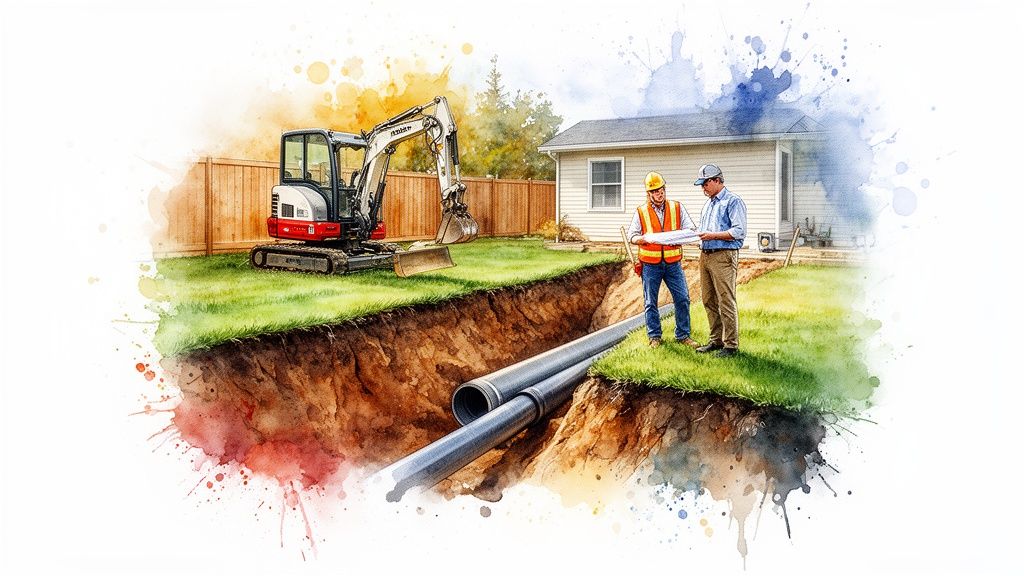
The marketing hype around trenchless technology often paints traditional excavation as an outdated, messy last resort. But here’s the truth: digging is frequently the smarter, safer, and more durable long-term solution.
When a pipe is severely compromised, open-trench excavation is the only method that guarantees a 100% fix. It allows a contractor to physically remove the entire damaged line and replace it with a brand-new one.
Advantages Of A Strategic Excavation
For homes on the Central Coast, where we deal with challenging soils, the benefits of a well-planned dig are clear. A carefully managed excavation provides a guaranteed solution that can last 50+ years.
Here's why digging often wins out:
- Permanent Slope Correction: If your pipe has a "belly," excavation is the only way to regrade the trench bed and install the new pipe with the perfect slope.
- Addressing Soil Issues: Digging exposes the surrounding soil, allowing us to see what caused the pipe to fail in the first place and fix it.
- Total Pipe Replacement: Unlike lining an old pipe, a full replacement removes all doubt. You get a completely new, high-performance line.
As we detail in our homeowner’s guide to residential excavation, a skilled excavator understands how your utilities fit into your property’s overall health.
Trenchless repairs fix the pipe; excavation fixes the problem. By addressing the surrounding environment, a strategic dig ensures the issue won't come back, offering true peace of mind.
Your Trenchless Repair Questions Answered
Here are straight answers to common questions homeowners in Sonoma and Monterey Counties ask about trenchless pipe repair.
How long does trenchless pipe lining last in California soils?
Manufacturers often cite a 50-year lifespan, but in California's shifting soils, reality depends on the original "host" pipe's condition. If the pipe is already sagging, the liner will follow those flaws, creating spots for future blockages. A full replacement via excavation is often smarter for structurally damaged pipes.
Will trenchless repair work with heavy tree root damage?
It depends. If roots have only entered through small cracks, they can be cleared before lining. However, if roots have collapsed or severely offset the pipe, a liner is just a temporary fix. A camera inspection is the only way to know if the pipe is strong enough for trenchless repair.
Is trenchless repair always less disruptive than digging?
While it saves your lawn from a long trench, "no-dig" isn't entirely accurate. The process still requires digging access pits at both ends of the damaged pipe. For homes with tight access or short repair sections, a small, targeted excavation can be just as efficient.
Can trenchless repair fix a pipe with a bad slope?
No, trenchless relining cannot fix a pipe's grade or slope. A liner will simply follow the existing path of the host pipe, including any "bellies" or sags. The only way to correct a poor slope is through traditional excavation, where the trench bed can be regraded before a new pipe is installed.
Why should I choose a contractor who does both trenchless and traditional excavation?
Always request a video inspection of the existing pipe before deciding. Make sure your contractor is experienced in both trenchless and traditional excavation—not just selling one method. A company that is an expert in both can provide an honest, unbiased recommendation based on your property's specific needs, ensuring you get the right long-term solution.
If you're weighing trenchless vs. traditional pipe repair in Sonoma or Monterey County, DW Excavation can help you make the right call—based on facts, not pressure. Let’s talk through your options.