It's a homeowner's worst nightmare. You’ve just paid for a beautiful new asphalt driveway, but within a year, it’s already sinking, holding puddles, or starting to heave—and there isn’t even a crack in sight. Your first instinct might be to blame the asphalt itself, but the real problem is almost always buried underground.
The hidden culprit is poor grading, a foundational mistake that dooms driveways from below long before the surface shows any obvious signs of damage. Homeowners often ask, “Why did my brand-new driveway crack or flood so quickly?” Many assume the asphalt was bad, when the real issue is what’s underneath.
Why Your New Driveway Is Failing From Beneath
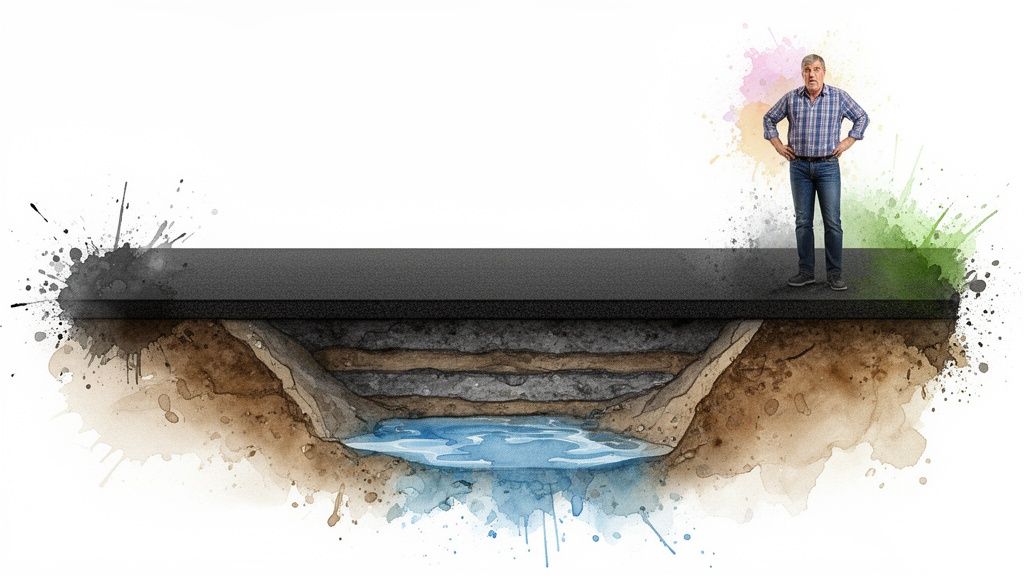
It’s completely understandable to think that a brand-new driveway failing within months must be due to a bad batch of asphalt. But the dark, smooth surface you drive on is just the top layer of a complex system. The real strength and lifespan of your driveway come from what’s underneath it: the prepared earth and compacted gravel base, known as the subgrade.
Grading is the crucial process of shaping and compacting this foundation to create a stable, properly sloped base. When a contractor cuts corners here, the driveway is set up to fail from day one. Even the highest-quality, most expensive asphalt mix will quickly fall apart if it's laid on an unstable or poorly drained foundation.
What Are the Early Warning Signs of a Bad Driveway Foundation?
Think of your driveway like a house. Without a solid foundation, the whole structure will eventually shift, sink, and crumble. Bad grading is the same as building that house on loose sand. You won’t see the asphalt crack right away, but you’ll definitely notice other alarming signs that point to deep-seated failure.
Keep an eye out for these early red flags:
- Persistent Puddles: If water sits on your driveway for hours or even days after it rains, it’s a sure sign the slope is wrong.
- Sinking or "Rutting": Are there noticeable dips where your car tires usually sit? That means the subgrade isn’t strong enough to handle the weight.
- An Uneven or Wavy Surface: A driveway that feels bumpy or looks rippled is settling unevenly because the base wasn't compacted properly.
- Crumbling Edges: When the sides of the driveway start to break apart, it often means the gravel base is washing away from underneath.
These aren't just cosmetic issues; they are clear symptoms of a failing foundation. For a deeper look into how the preparation process should be done right, check out our guide to Monterey driveway excavation and leveling.
Knowing how poor grading wrecks driveways before the asphalt even cracks empowers you to spot these red flags early and tackle the real problem before it gets worse.
Understanding Your Driveway's Unseen Foundation
When your brand-new driveway starts to sink, it’s easy to point the finger at the asphalt or concrete. But the real problem often lies hidden beneath the surface. The true strength of any driveway is in its unseen foundation—the subgrade and the precision of the grading.
The subgrade is simply the native soil that everything is built on. Grading is the art and science of shaping and compacting that soil to create a stable base that sheds water effectively. Think of it like building a house; you wouldn't build on a wobbly, tilted foundation, right?
The Two Critical Jobs of Expert Grading
Proper grading has two non-negotiable jobs. First, it involves compacting the soil to create a uniform, rock-solid platform. This gets rid of the soft spots that eventually turn into ugly ruts and potholes.
Second, it establishes a precise slope—at least a 2% grade is the industry standard—to make sure every single drop of rain flows away from the pavement. When a contractor cuts corners here, they’re setting your investment up for a short, expensive life. In fact, poor drainage resulting from improper grading is behind the majority of premature driveway failures [US Department of Transportation].
What this actually means for you is that even the best asphalt will fail if the subgrade isn’t compacted correctly or sloped to drain water. And in Monterey’s clay-heavy soils, poor drainage leads to waterlogged driveways and rapid erosion.
Proper Grading vs. The Consequences of Cutting Corners
This table breaks down the essential goals of professional grading and shows the costly damage that happens when these standards aren't met.
| Grading Objective | Why It Matters for Driveway Longevity | The Result of Poor Grading |
|---|---|---|
| Uniform Compaction | Creates a solid, stable base that evenly supports the weight of the driveway and vehicles. | Settling and Sinking: Soft spots in the subgrade collapse, creating dips, ruts, and an uneven surface. |
| Precise Sloping (Min. 2% Grade) | Actively directs rainwater and runoff away from the driveway surface and your home's foundation. | Water Pooling and Damage: Water sits on the surface, seeping into cracks and weakening the base, leading to potholes and "alligator" cracking. |
| Proper Base Material | A layer of crushed stone or gravel provides a strong, load-bearing layer that also helps with drainage. | Subgrade Erosion: Without a proper base, water erodes the soil foundation from underneath, causing sections of the driveway to collapse. |
| Smooth, Even Surface | Ensures there are no low spots where water can collect, freeze, and expand, causing damage. | Freeze-Thaw Heave: Trapped water freezes, expands, and pushes the pavement up, creating bumps and cracks that worsen each year. |
As you can see, what happens underneath your driveway is just as important—if not more so—than the surface you see every day.
The damage doesn't stop at your driveway, either. Water that pools near your home can saturate the soil around your foundation, leading to far more serious problems. You can learn more in our guide to foundation services on the California Central Coast.
How Water Becomes Your Driveway's Worst Enemy
When grading goes wrong, water turns from a simple rain shower into a destructive force. A properly engineered driveway isn’t perfectly flat. It has a subtle but critical tilt—at least a 2% slope—that actively guides every drop of rain away from the surface and its foundation.
Without that slope, water has nowhere to go. It pools on the asphalt, creeps into the nearly invisible seams at the edges, and slowly saturates the subgrade. This trapped moisture is where the real trouble starts, turning stable, compacted soil into a soft, sponge-like mess that can no longer support the weight of your car.
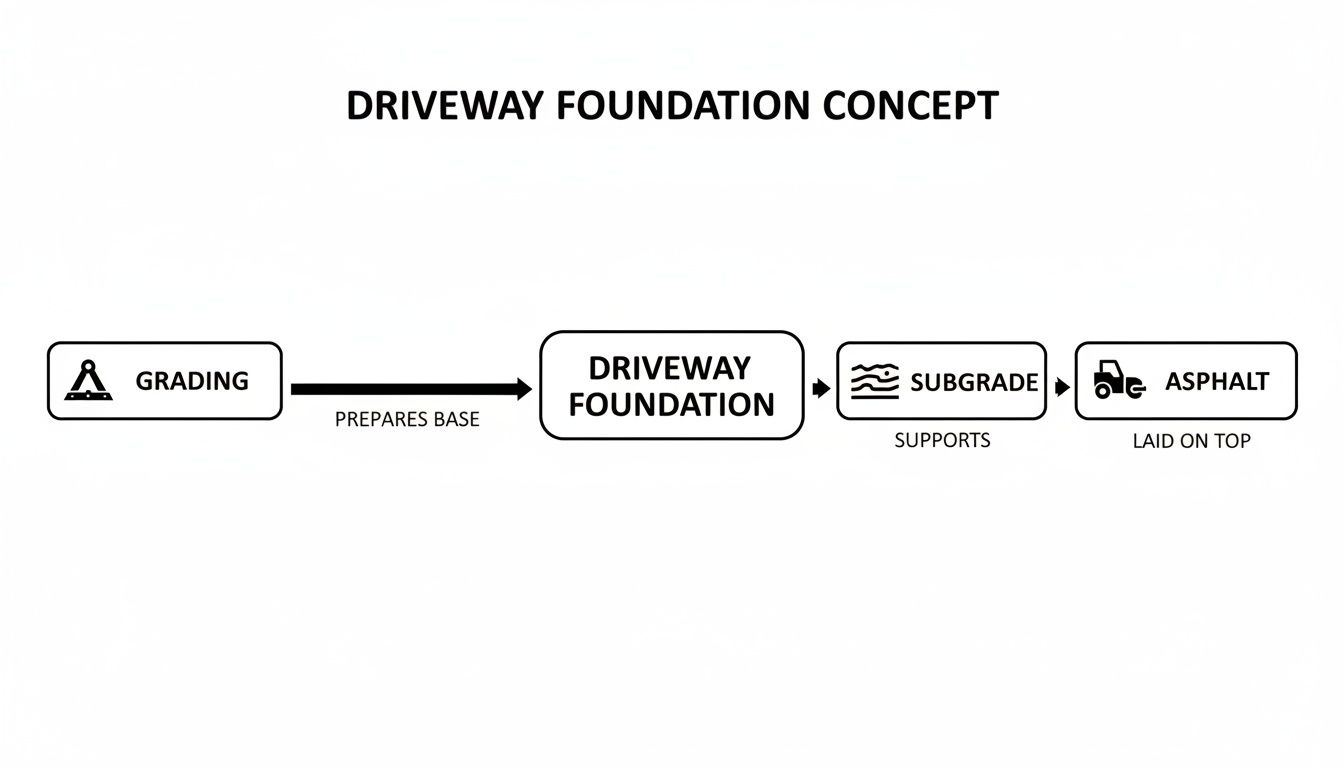
As you can see, each layer depends completely on the one beneath it. A mistake in the initial grading compromises the whole system. This is how poor grading wrecks driveways long before the asphalt even cracks, because all the damage is happening out of sight.
The Power of Freeze-Thaw Cycles
If you live in an area that sees freezing temperatures, that trapped water becomes even more destructive. When water freezes, it expands by about 9%, exerting incredible upward pressure on the asphalt from below. This force is called frost heave, and it's strong enough to lift entire sections of your driveway.
When the ice thaws, it leaves behind empty pockets and a soggy, weakened subgrade. The asphalt, now unsupported, collapses into these voids. This cycle of heaving and collapsing repeats all winter, breaking your driveway’s structural integrity apart from the inside out.
Why Monterey and Sonoma County Soils Are Vulnerable
This problem is a nightmare in the clay-heavy soils common throughout Monterey and Sonoma Counties. Clay soil acts like a dense sponge; it absorbs and holds onto water far longer than sandy or loamy soils do. When a poorly graded driveway on a clay base gets saturated, the subgrade loses almost all of its strength.
In regions like Sonoma and Monterey Counties, with heavy rains and clay-heavy soils, poorly graded driveways can see up to 50% faster base deterioration [Soil Science Society of America, 2022]. The combination of water retention and poor drainage is a recipe for rapid failure. This vulnerability makes professional water management non-negotiable for any paving project in our area. You can read more about our approach to water management solutions in Monterey.
Red Flags of Poor Grading You Can Spot Yourself
You don’t need to be an engineer to see the early warning signs of a failing driveway foundation. While cracks might not show up for months or even years, the symptoms of poor grading are often visible to the naked eye long before your pavement starts to fall apart.
Knowing what to look for lets you have an informed conversation with a contractor before small issues spiral into catastrophic failures. A lot of homeowners mistakenly think that a brand-new, smooth surface means everything is fine. The reality is that poor grading wrecks a driveway by destroying the unseen subgrade first.
Visible Symptoms of an Unstable Base
Catching these problems early can be the difference between a simple fix and a complete driveway replacement. Take a walk around your driveway, especially right after a rainstorm, and look for these tell-tale signs:
- Persistent Puddles: If water pools on your driveway and just sits there for hours or days after a storm, that’s a dead giveaway the slope is wrong.
- Sunken Ruts: See those noticeable depressions or "ruts" where your tires always travel? That means the subgrade wasn't compacted correctly.
- A "Wavy" or Uneven Surface: Does your driveway feel bumpy when you drive on it, or look like it has ripples? This uneven settling happens when the soil and gravel base weren't uniformly packed.
- Crumbling Edges: When the sides of your driveway start to fray and fall apart, it's often because the base material is washing away.
Recent insights show that grading and compaction are the most overlooked parts of residential paving. One Reddit user shared that weeds grew through the asphalt within days because no proper base layer was installed. If you're dealing with similar issues, our guide to fixing drainage and grading problems can provide more in-depth solutions.
Understanding Steep Slopes and Mismatched Grades
Steep or improperly matched grades can also destabilize a driveway’s foundation right from the start. Most local codes cap driveway grades between 10-18%, as anything over 20% is just asking for rapid erosion and puts a ton of strain on your vehicle [Angi]. You can learn more about how experts view maximum driveway slopes on Angi.com.
The DW Excavation Approach to a Bulletproof Driveway
At DW Excavation, we’ve seen it a hundred times: a beautiful new driveway that starts failing within a few years. We operate on a simple principle: poor grading wrecks driveways before the asphalt even cracks. That’s why our process is obsessive about the unseen foundation.
We analyze the soil composition—especially the tricky clay soils common in Monterey and Sonoma County—and carefully map out how water naturally flows across the land. Getting this right from the start is the key to designing a subgrade that will stay stable for decades, not just a few seasons.
How We Engineer a Foundation for Durability
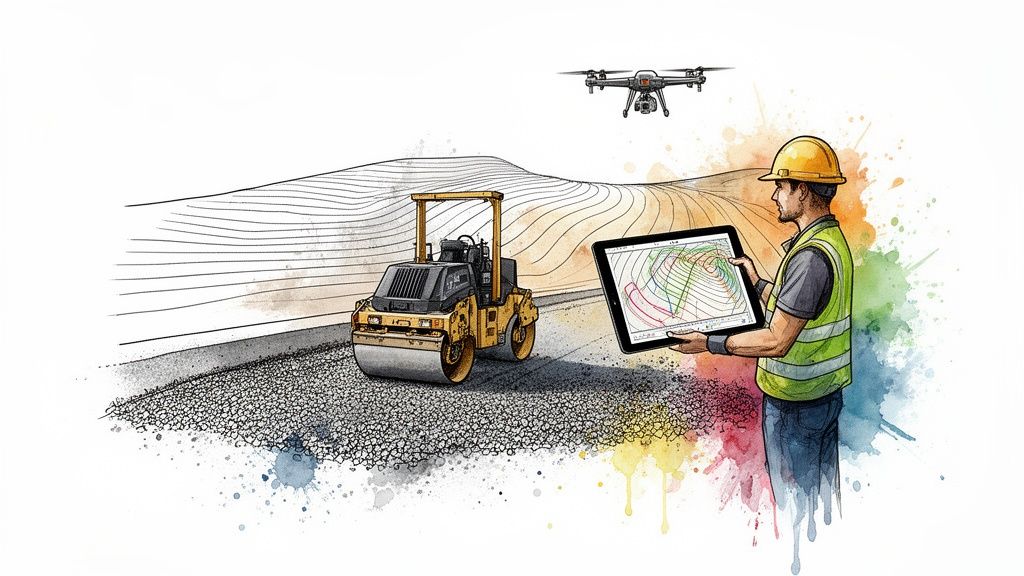
Old-school methods just don't cut it anymore. We bring modern technology to every job to guarantee a level of precision that was impossible just a generation ago. By using advanced tools like GPS grading and drone mapping, we make sure every square inch of the subgrade is perfectly sloped and uniformly compacted.
Here’s a look at how we get it done:
- GPS-Guided Grading: This tech allows our heavy equipment to sculpt the ground with sub-inch accuracy, creating the perfect slope to shed water away from your driveway and home.
- Systematic Compaction: We build the base in carefully measured layers. After each layer is added, we test its density to crush any weak spots that could lead to sinking or ruts.
- Integrated Drainage Solutions: If your property needs it, we'll engineer and install drainage systems like French drains or catch basins to actively manage heavy runoff.
This commitment to getting the foundation right is what sets our work apart on the Central Coast. We don’t just give you a new driveway; we deliver a long-term solution engineered to withstand our region's specific environmental challenges. Explore our full range of engineering-integrated excavation services to learn more.
How to Hire a Contractor and Avoid Costly Regrets
Choosing the right contractor is probably the biggest decision you'll make for your new driveway. It's tempting to jump on the cheapest bid, but that can quickly become the most expensive mistake you make. When a poorly prepared base fails, the only fix is a complete, and costly, replacement.
A true professional will welcome your questions about their process—it shows they know their stuff and aren't cutting corners. If you get a vague or evasive answer, that’s a huge red flag. As we've discussed, the reality of how poor grading wrecks driveways before the asphalt even cracks means getting the foundation right is everything.
What Questions Should I Ask a Paving Contractor?
Before you sign a contract, arm yourself with a few key questions. You want to know what's happening underneath, not just what the final blacktop will look like. Before hiring a paving contractor, ask: What’s your base compaction process? and Do you check drainage slope?
Always get these details in writing—not just a price per square foot. Here are a few more critical questions:
- How do you verify the drainage slope? You want to hear them talk about using tools like a laser level or advanced GPS grading equipment. If they say they "eyeball it," walk away.
- How will you manage the clay soils on my property? Any contractor with real experience in Monterey County knows our soil. They should have a clear strategy, whether it’s amending the soil, adding a geotextile fabric, or building a thicker gravel base.
- Can you provide local references for similar projects? Speaking with past clients is one of the best ways to vet a contractor’s quality and professionalism.
A low-ball price means nothing if your driveway is a sunken, cracked mess in two or three years. Poor site grading can also send water toward your home, causing serious foundation cracking and water intrusion. To learn more about that connection, check out our guide on hiring qualified foundation contractors.
Frequently Asked Questions About Driveway Grading
As experts in everything that happens below the surface, we get a lot of questions from frustrated homeowners. Here are some of the most common ones we hear, with straightforward answers.
Why did my new driveway sink within a year?
That sinking or rutting you're seeing is almost always a sign of a poorly compacted subgrade. Before the asphalt was laid, the soil and gravel underneath should have been tightly compressed with heavy machinery. When that step is rushed, it leaves behind air pockets that collapse under the weight of your car, causing the surface to sink.
Can I just pave over my old cracked driveway?
Putting a new layer of asphalt over a failing driveway is like putting a fresh coat of paint on a rotting wall. It might look good for a season, but it does nothing to fix the real problem. The new asphalt will simply follow the old cracks and sink right along with the weak base beneath it, usually within a couple of years.
How steep can my driveway be in a hilly area like the Central Coast?
This is a critical question, especially for properties in places like Monterey or Sonoma County. A driveway's slope generally shouldn’t exceed a 12% to 15% grade [Angi, 2024]. Anything steeper becomes a safety hazard and a major erosion risk from water runoff, which is why a professional grading plan is essential.
What is more important: asphalt thickness or subgrade prep?
Subgrade preparation is, without a doubt, more important. You could lay the thickest, most expensive asphalt mix on the market, but if it’s sitting on a weak, poorly drained foundation, it will fail. A properly graded, sloped, and compacted subgrade is the single most important factor for a long-lasting driveway.
How much does proper driveway grading cost in California?
The cost depends on your property’s unique conditions—the existing slope, soil type, and the size of the driveway. While proper grading and compaction add to the initial investment, it’s by far the more cost-effective choice. It saves you from spending thousands on frustrating repairs and premature replacement down the road.
If you're planning a new driveway in Monterey or the Central Coast, talk to DW Excavation first. We pave with long-term performance in mind—because it’s what’s beneath the surface that really counts. Learn more at https://dw-excavation.com.