
If you're laying out parking for a new build, remodel, or restripe in California, the handicap parking size space has to be right before the asphalt goes down. A few inches off, or a surface that drains the wrong way, can turn a simple parking area into a compliance problem that costs time and rework.
Quick Answer
A standard handicap parking size space is at least 96 inches wide with a 60-inch access aisle beside it. A van-accessible space is 132 inches wide with a 60-inch aisle or 96 inches wide with a 96-inch aisle, which allows safe ramp or lift use. In California, those dimensions still have to work with Title 24 slope, access-route, and site-grade requirements, so the layout has to be right on paper and right in the field.
Introduction
You might be staring at a site plan, a restriping proposal, or a rough-graded lot and wondering whether the accessible parking layout will pass. That concern is valid, especially in California, where a compliant handicap parking size space depends on more than paint and signs.
The hard part isn't just knowing the published dimensions. It's making the ground, drainage, striping, and access route all work together so the finished lot holds compliance after traffic, weather, and use.
ADA Handicap Parking Size Space Explained
Accessible parking fails in the field for a simple reason. The painted stall looks right, but the usable space is wrong.
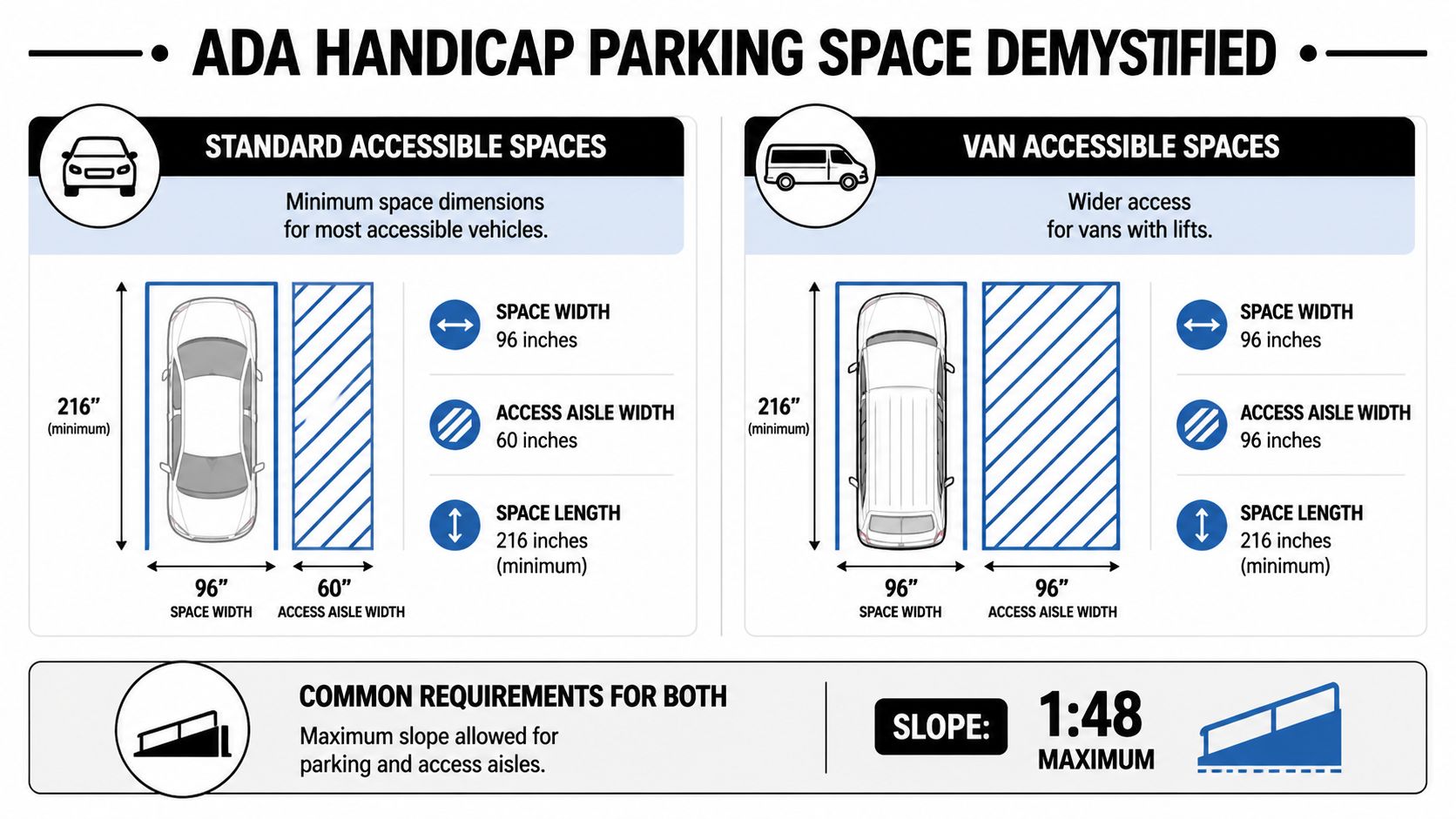
Standard accessible spaces
Under federal ADA standards, a standard accessible parking space uses a 96-inch stall with a 60-inch access aisle beside it. Those are the starting dimensions, not the whole inspection standard.
The access aisle has to function in real use. If a curb nose, sign post, wheel stop, or striping error cuts into that area, the space stops working the way it was intended to. I see that mistake on restripe jobs all the time. The tape measure may hit the painted lines, but the person using the stall loses clear room to transfer in or out of the vehicle.
Van-accessible spaces
Van spaces give you two common layout options under the ADA. One uses a 132-inch-wide stall with a 60-inch aisle. The other uses a 96-inch stall with a 96-inch aisle.
The better choice depends on the site, not just the plan sheet. On a tight lot, the narrower stall with the wider aisle can fit the geometry better. On another property, the wider stall may create a cleaner layout near the curb ramp and accessible route. California projects need extra care here because state rules and field tolerances can make a layout that looks acceptable on paper turn into a correction order after paving.
Why the access aisle gets projects in trouble
The access aisle is working space. It is not leftover room between stalls.
That means it has to stay clear and identifiable after the project is finished. Utility lids, bumper blocks, garden edging, and poorly placed posts regularly create failures. Shared aisles between two accessible stalls can be a good use of space, but only if the dimensions, striping, drainage, and pedestrian path were coordinated before the crew starts setting forms and pulling grades.
Plans matter, but field layout matters more
A lot of parking problems start with plans that are hard to read or poorly coordinated. The civil sheet shows one width, the striping plan shows another, and the grading crew has already locked in elevations by the time someone notices. Owners who want to catch that early should understand how to read blueprints for site work.
For a second check on common misses, this guide to avoiding ADA inspection failures is useful because it focuses on the field conditions that trigger corrections, not just the published dimensions.
On California jobs, that distinction matters. A compliant handicap parking size space depends on the stall width, the aisle, the route to the entrance, and the finished surface all lining up after grading, paving, and striping are complete.
How Many Accessible Spaces Do You Need?
Count the spaces before anyone finalizes striping or pours curbs. If that count is wrong, the whole layout drifts off course and the fix usually costs more after paving than it would have during planning.
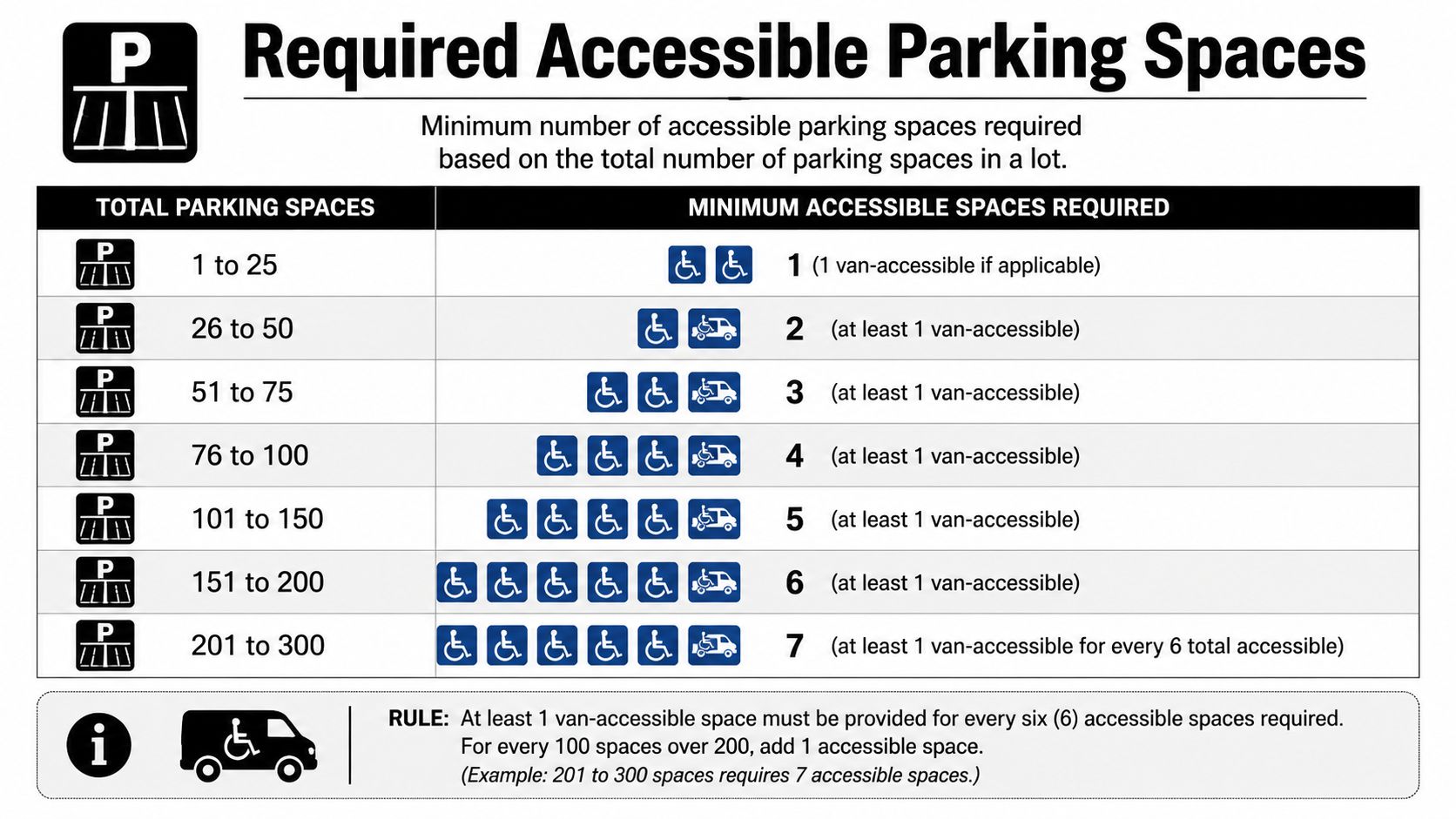
ADA parking count by lot size
The ADA sets the required number of accessible spaces by the total parking count. A lot with 1 to 25 spaces requires 1 accessible space. A lot with 76 to 100 spaces requires 4, and lots with 501 to 1,000 spaces require 2% of the total to be accessible, according to ADA parking count requirements.
For day-to-day planning, these are the ranges owners and contractors usually check first:
| Total parking spaces | Minimum accessible spaces |
|---|---|
| 1 to 25 | 1 |
| 26 to 50 | 2 |
| 51 to 75 | 3 |
| 76 to 100 | 4 |
| 101 to 150 | 5 |
On small commercial jobs, this is often where owners get tripped up. They assume the count is simple, then find out the actual challenge is fitting those spaces where the route, curb ramps, and grades will still work in the field. If the lot is still in design, review whether a site plan is needed even for a small project before the layout gets locked in.
The van space requirement
Van spaces have their own count requirement. For every 6 accessible spaces required, at least 1 must be van-accessible.
That needs to be settled early. On actual job sites, the van stall is usually the first one that exposes a bad parking layout because it needs more room and a cleaner approach. If standard stalls take the best frontage first, the van space often ends up forced into a corner where maneuvering, signage, drainage, or the path to the entrance becomes harder to make compliant.
Count the required accessible spaces first. Then place them where the grades, access aisle, and pedestrian route can actually be built correctly.
Separate facilities can mean separate counts
Accessible parking counts can apply by facility, not just by the property as a whole.
That matters on mixed-use sites, medical offices, retail centers, and larger developments with separate parking areas serving different users. A customer lot and an employee lot may need to be evaluated separately. If that gets missed during layout, the correction usually lands on the paving and striping side of the job, where changes are slower and more expensive.
California owners should pay close attention here. Federal minimums are only part of the picture, and on-site layout decisions need to hold up under California review once the work is built.
California Rules That Go Beyond the ADA
Federal rules are only the floor. In California, the job doesn't end when the ADA dimensions pencil out.

Title 24 changes how you approach the layout
California projects have to account for Title 24, which adds stricter accessibility expectations on top of the federal baseline. For a property owner in Sonoma County, Monterey County, or along the California Central Coast, that means the accessible parking discussion needs to happen during grading and paving prep, not after striping.
The biggest practical issue is that California enforcement tends to focus on the details owners assume are minor. Slope transitions, sign placement, route continuity, and field measurements all matter because that's what inspectors and accessibility specialists look at on the ground.
Why CASp review is worth taking seriously
A Certified Access Specialist, or CASp, can identify problems before they turn into correction notices, restriping, or concrete work. That review is especially useful on remodels, tenant improvements, and properties with older paving where surfaces have settled over time.
A lot can look finished and still not be ready. Once the striping is complete and the signs are installed, owners often assume the accessible spaces are done. If the grades or route don't match what California expects, you're back to sawcutting, patching, or replacing sections that should have been built right the first time.
Site approval starts long before final striping
Accessible parking problems often begin in plan coordination. Civil sheets, architectural sheets, and paving layouts don't always line up cleanly, and one mismatch can ripple through the whole parking field.
If a project is still moving through approvals, it helps to understand how to get a site plan approved faster because accessible parking is one of those areas where a small drafting miss can delay permits or trigger plan corrections.
California doesn't treat accessible parking as a striping issue. It treats it as a site construction issue.
Why Grading and Site Prep Are Key for Compliant Parking
A parking lot can look finished on Friday and fail on Monday when the inspector puts a digital level on the accessible stall. That usually traces back to grading, not paint.
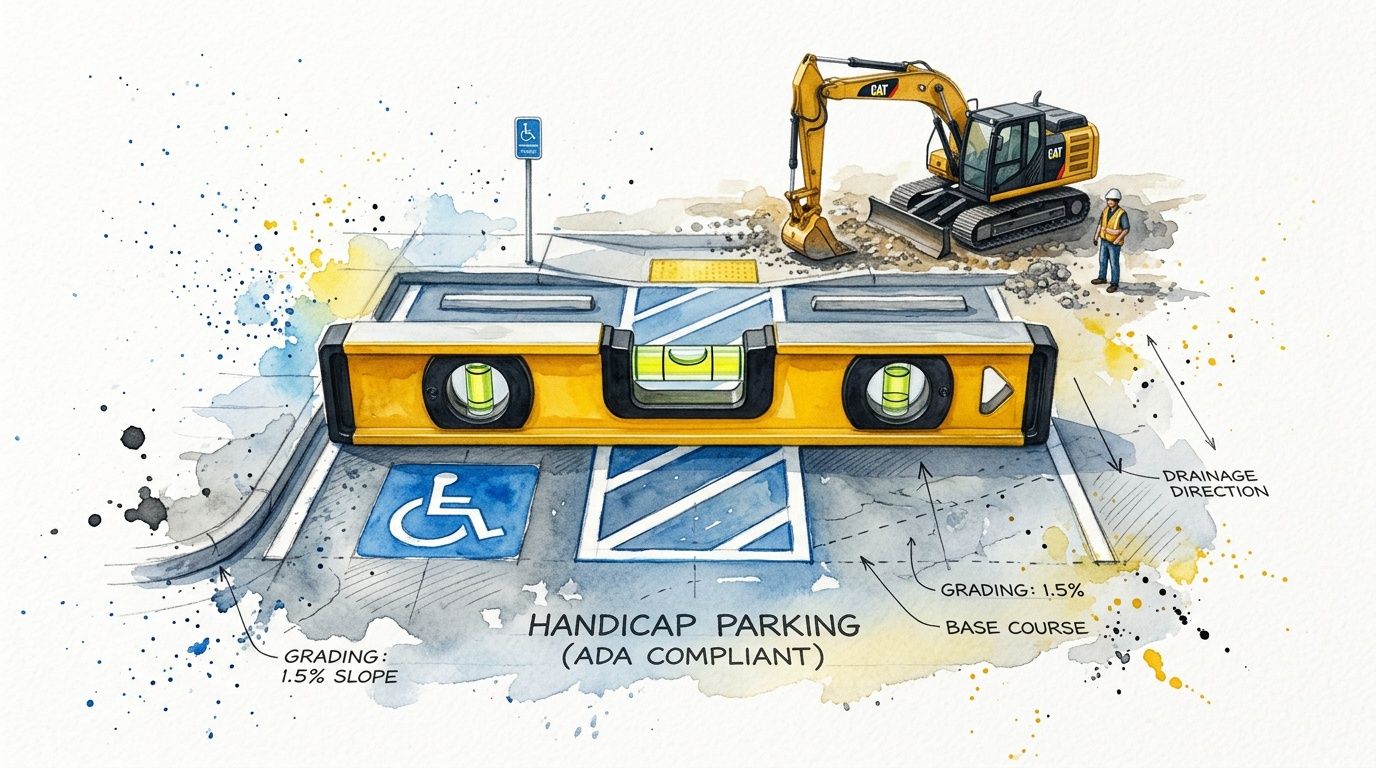
Slope is where lots fail
Accessible parking has a hard limit. The stall and access aisle must be no steeper than 2% (1:48) in any direction, per ADA parking guidance. California projects run into trouble here because drainage still has to work, and pushing water through the accessible area is a common design and construction mistake.
On the ground, this is a grading problem first. If the crew builds the lot to drain across the stall, no amount of restriping will fix it.
The subgrade and base matter
The finished surface only holds if the layers under it were cut, compacted, and shaped correctly. I see failures show up after patching old pavement, after utility trench repairs, and in areas where the base was left inconsistent from one side of the stall to the other.
That is why accessible parking needs to be set with grade control early. The elevations for the stall, access aisle, curb ramp tie-in, and nearby drainage all need to agree before base rock is placed and before asphalt or concrete goes down. California Title 24 raises the stakes because field tolerances and route usability get checked closely, not just the striping layout.
Common field failures
The problems are usually predictable:
- Drainage pitched through the stall or aisle: Water moves, but the accessible area ends up too steep.
- Soft or uneven base: The surface settles and falls out of tolerance after opening.
- Trench and patch repairs through the space: Repaired sections move differently than the surrounding pavement.
- Late layout shifts in the field: A crew steals inches from the aisle or rotates the stall to make the parking count work.
- Poor coordination between trades: Grading, paving, concrete, and striping each follow different benchmarks.
None of those problems start with signage. They start with earthwork, elevations, and compaction.
What good grading looks like
Good grading is deliberate. The accessible area is identified early, benchmarked clearly, and protected during construction so other site adjustments do not distort it at the end of the job.
For owners, the practical question is simple: will this surface still hold slope after traffic, weather, and minor settlement? If you want a clearer way to judge the work, review how to know if grading was done right.
A stall can look flat and still fail. A level, a wheel path, and one rainy season usually expose the difference.
Signage and Marking Requirements
Once the surface is right, the visual part of the work still has to be done correctly. A properly built handicap parking size space can still fail if the signs and pavement markings are sloppy, missing, or placed where drivers can't read them.
What owners should check before calling the job done
Every accessible stall needs clear identification, and van spaces need additional van designation. The field problem isn't usually that people forget signs entirely. It's that signs go in too low, get blocked by parked vehicles, or don't match the final striping layout.
Pavement markings matter too. Access aisles need to be visibly marked and kept out of service for parking, because drivers will use any unmarked open area as overflow if the layout is unclear.
A few practical checks go a long way:
- Match the signs to the stall type: A van stall needs van identification, not just a standard accessibility sign.
- Keep markings readable: Faded hatch marks and worn symbols create confusion fast.
- Coordinate striping with paving work: Fresh paving prep and proper surface condition help markings last longer. If you're already planning lot improvements, review parking lot paving services on the California Central Coast.
- Walk the lot from a driver's view: If the sign disappears behind a vehicle or landscaping, placement needs another look.
For owners comparing maintenance approaches in other markets, this overview of solutions for DFW parking lots is a useful example of how striping, cleaning, and visibility issues affect parking areas after construction.
Marking mistakes that create trouble
Aisle striping that's too light, inconsistent hatch spacing, and signs installed as an afterthought all create problems. On older sites, resurfacing can also bury or distort markings if the lot is overlaid without reworking the accessible layout first.
The right approach is simple. Build the surface correctly, stripe to the approved layout, install the signs where they stay visible, and maintain them like any other safety feature on the property.
FAQ About Accessible Parking Spaces
Do older parking lots get a pass if they were built years ago?
Older lots still create problems when they don't provide accessible parking that works in real use. If you're altering, resurfacing, or reconfiguring the site, it's smart to assume the accessible parking layout deserves close review instead of assuming age protects it.
Can I just repaint my existing stalls to make them compliant?
Sometimes, but often not. If the stall width, aisle width, slope, drainage, or route to the entrance is wrong, new paint won't fix the underlying issue. The lot has to be physically capable of supporting a compliant layout.
Why do access aisles cause so many failures?
Because they're easy to undervalue during design and easy to damage in the field. People see the aisle as unused space, but it has to stay open and functional for wheelchair loading, unloading, and maneuvering.
Who should check the layout before paving starts?
The design team and contractor should sort it out before final grading and paving, and California owners are often wise to involve accessibility review early. Catching a conflict on paper is a lot easier than correcting concrete, asphalt, or drainage after installation.
What's the most common mistake on a handicap parking size space project?
Treating it like a striping task instead of a site construction task. Most of the expensive fixes happen because the grades, drainage, or stall placement were wrong before the painter ever arrived.
How do I know if my lot needs more than one van-accessible stall?
That depends on the total number of accessible spaces required for the lot. Once the accessible count reaches the threshold where another van space is triggered, the layout has to account for it in a way that still preserves circulation and a usable path to the building.
For property teams responsible for ongoing upkeep after installation, this guide for facility managers is a helpful read on how striping maintenance affects day-to-day lot performance.
Call to Action
A parking lot can look finished and still fail the day an inspector checks slopes, access aisles, or the path to the entrance. In California, that usually means rework no owner wants to pay for twice.
Getting a handicap parking size space right means coordinating layout, grading, drainage, paving tolerance, signage, and striping before crews mobilize. The expensive problems rarely start with paint. They start earlier, when the pad is set a little high, water is pushed into the aisle, or the stall location works on paper but not on the ground under Title 24 requirements.
If your project includes parking improvements, new construction, or access upgrades, review the site before excavation and paving prep are locked in. That is the point where small corrections are still manageable.
If you need a practical review of accessible parking layout, grading, or paving prep, DW Excavation, LLC can help you assess the site before avoidable mistakes turn into demolition and replacement. Call (707) 601-9091 or visit 470a Caletti Avenue, Windsor, CA 95492 to discuss your project in Sonoma County, Monterey County, or the California Central Coast.