
You pull into the driveway after a rain and see the same trouble spots again. Water is sitting near the garage, the wheel path has started to sink, and the cracks that looked cosmetic last year now feel like a warning. At that point, the cost to repave driveway asphalt is no longer just about new blacktop. It depends on whether the surface is worn out, or the base underneath is starting to fail.
That difference changes the price in a hurry.
A driveway with a stable base may only need resurfacing. A driveway with soft spots, poor grading, or trapped water often needs excavation, base repair, and drainage work before any paving crew should lay asphalt. Homeowners usually focus on the finish because that is what they see. In the field, the foundation is what decides whether the new surface stays smooth or starts cracking back through.
If you want a clearer picture of why base prep matters so much, this guide on what really makes pavement last explains what is happening below the surface.
Quick Answer
The cost to repave driveway asphalt usually depends on square footage, demolition, base condition, grading, and drainage, not just the new blacktop itself. If the base is sound, resurfacing may be enough. If the driveway is sinking, showing extensive cracks, or holding water, a proper estimate needs an on-site look at the base and subgrade. For a closer look at what makes pavement hold up, this explanation on what really makes pavement last is worth reading.
Is Your Driveway a Problem Waiting to Happen?
A driveway usually tells you when it's near the end. You see alligator cracking, potholes, edges breaking off, or tire tracks where water keeps sitting. Sometimes the worst issue isn't the asphalt surface. It's the soft base, poor drainage, or settlement underneath.
When homeowners search for the cost to repave driveway asphalt, they're often hoping for a simple square-foot answer. That would be easier, but it rarely matches what happens in the field. Two driveways can look similar from the street and need very different work once the crew checks slope, drainage path, edge failure, and the condition of the underlying base.
Practical rule: If water stands on the driveway or runs toward the house, treat that as a site issue first and a paving issue second.
A repaving job lasts when the surface, base, and soil all work together. If one layer has failed, the paving number alone doesn't tell you much.
What Really Determines Your Repaving Cost?
The headline price on a paving project can look like it's mostly about asphalt tonnage. It isn't. A driveway is a system made up of the visible surface, the aggregate base below it, and the prepared soil under that. Nationally, the average cost to repave an asphalt driveway ranges from $1,400 to $12,100, with a national average of $6,800 for a typical 600 square foot two-car driveway, according to HomeAdvisor’s 2025 driveway repaving data.
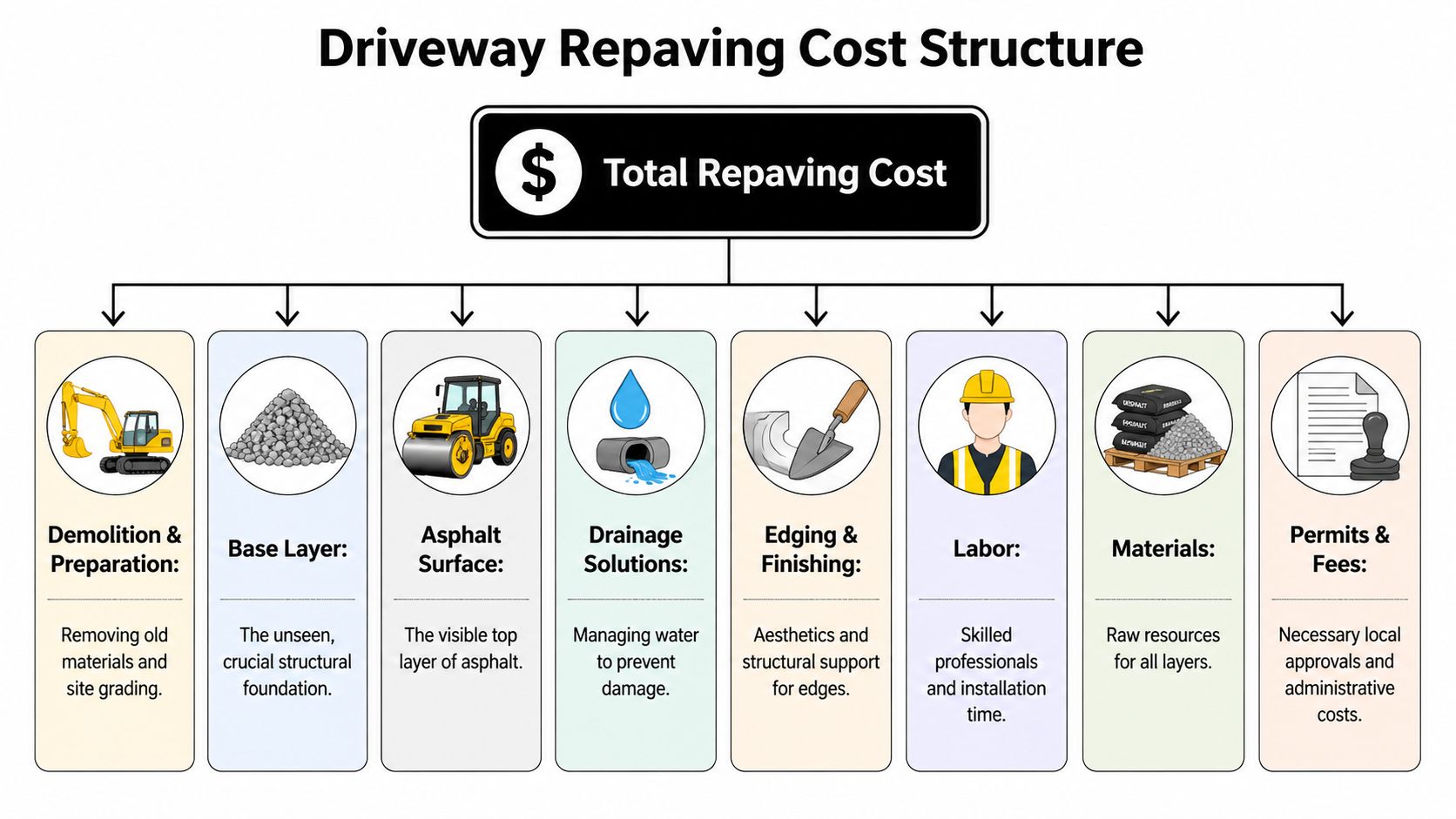
The surface is only one layer
The top layer gets most of the attention because it's what you see. Asphalt is often chosen because it cures quickly and generally costs less than concrete or pavers, but surface material alone doesn't solve base movement, poor slope, or edge breakdown.
If the driveway only has age-related wear and the structure below is still stable, repaving can make sense. If cracks reflect movement from underneath, fresh asphalt will usually mirror that failure pattern again.
Base condition changes the whole job
The base is where a lot of jobs are won or lost. If it's stable, compacted, and draining correctly, the paving crew can build on it. If it's soft, washed out, or uneven, the driveway needs more than a new skin.
That’s why grading matters before paving starts. If you're trying to understand when this step becomes necessary, this guide on whether grading is needed before repaving a driveway lays it out clearly.
Demolition and prep can outweigh expectations
Removing the old surface, hauling debris off site, reshaping the grade, and rebuilding weak areas often add more than homeowners expect. Those costs aren't extras in the bad sense. They're what prevent the new asphalt from failing over the same weak spots.
A neat paving finish over a bad subgrade is short-term cosmetic work. Good prep is what makes the job hold up.
Drainage is a structural issue
Water does most of the damage people blame on asphalt. It softens weak subgrade, opens cracks wider, undermines edges, and creates low spots that get worse over time.
When a driveway keeps failing in the same place, the usual cause is below the surface.
That's especially true on sloped properties and older sites where runoff was never managed correctly. In those situations, the actual cost is tied to correcting the conditions underneath, not just replacing the material on top.
A Line-Item Breakdown of Repaving Project Costs
A repaving estimate should show where the money is going below the surface, not just the finished blacktop. The asphalt itself matters, but the parts that usually change the price are removal, base correction, grading, and drainage. That is why two driveways with similar square footage can carry very different bids.
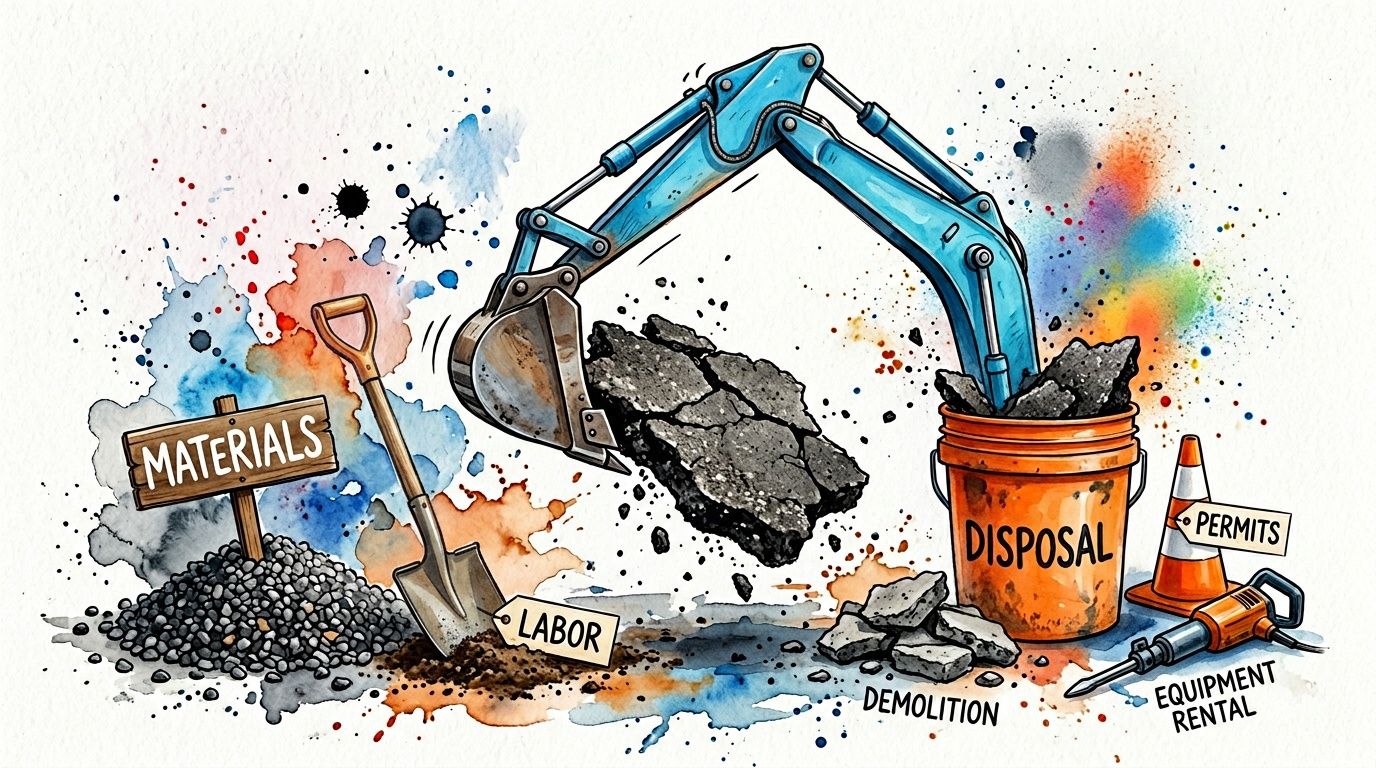
Removal and disposal
If the existing asphalt is cracked through, heaved, or broken over soft spots, removal is usually the right starting point. Crews need to break out the old pavement, load it, haul it off, and expose what is happening underneath. Angi’s repaving cost guide notes that materials often make up a smaller share of the job than labor and site preparation, and demolition or excavation can add meaningful cost when the old surface has to come out.
This line item also changes with access. A driveway with room for equipment is faster and cheaper to clear than a narrow approach with fences, retaining walls, or a garage close to the work area.
Excavation and grading
This is the part homeowners tend to underestimate. If water sits near the garage, runs down the wheel path, or washes out the shoulder, the driveway usually needs more than a fresh layer of asphalt. The crew may need to cut out weak sections, reset the slope, rebuild low areas, and compact the subgrade so the paving crew is not laying asphalt over movement and moisture.
On jobs like that, grading is not an add-on. It is part of making the new pavement last.
The bond between layers matters too, especially at transitions and patches. This short article on how asphalt tack oil helps old and new pavement bond properly explains why those joints fail when they are handled poorly.
Base repair or replacement
A driveway can only perform as well as the base under it. If the aggregate is stable, well compacted, and dry, the paving crew can place asphalt with confidence. If the base is pumping water, full of fines, or settled in sections, that material has to be removed or reworked first.
This is often the line item that separates a cosmetic overlay from a proper repaving job. Replacing bad base costs more up front, but it usually prevents the same cracks and depressions from showing back up in the same spots.
Drainage improvements
Drainage work may include correcting pitch, opening a swale, protecting edges, or directing runoff away from the pavement area. On some properties, that work is minor. On others, it is the reason the driveway failed in the first place.
If the estimate lists drainage as a vague allowance, ask what is included. A clear scope should explain where the water goes after the project is done.
Asphalt installation and finish work
Once the site is ready, the paving portion is fairly straightforward. The crew places the asphalt, compacts it to the right density, ties it into the garage or street, and finishes edges and transitions so the mat holds together under traffic.
Good finish work shows up later. Clean tie-ins, consistent thickness, and supported edges help the surface wear evenly instead of breaking down early at the margins.
What changes with project size
Larger driveways usually need more material and more labor, but area alone does not control the final number. Long runs, curves, steep sections, and drainage trouble often add more cost than homeowners expect because they increase prep time and make grade control harder.
| Driveway size example | What often changes in scope | What to review in the estimate |
|---|---|---|
| Small single-car driveway | Tight access can slow demolition and paving | Minimum charges, tie-ins, edge support |
| Standard two-car driveway | Typical mix of prep, base correction, and paving | Base repair allowance, slope correction, thickness |
| Wide or long driveway | More haul-off, more grading checks, more compaction | Material quantities, low spots, traffic load areas |
| Sloped or winding driveway | Runoff control and edge stability become bigger issues | Drainage plan, erosion control, shoulder support |
Ask for the scope in plain language. If a contractor cannot explain the excavation, grading, and drainage work, the estimate is missing the part of the job that usually decides how long the driveway will hold up.
How Driveway Size and Complexity Affect Your Estimate
A 1,000 square foot driveway with good access, stable base, and clean drainage can cost less to repave than a 400 square foot driveway with steep grade, tight turns, and water running across it. Homeowners often focus on square footage first. Paving crews and excavation contractors look at how hard the site is to prep, grade, and keep dry.
As noted earlier, national cost guides put repaving prices in a broad per-square-foot range and show that larger driveways usually cost more in total. That helps with budgeting. It does not tell you whether your estimate will stay reasonable or climb because the site needs correction before the asphalt truck shows up.
Factors influencing cost by driveway size
| Driveway Type | Typical Size (Approx.) | Key Cost Considerations |
|---|---|---|
| Short single-car driveway | Small | Tight working room, tie-ins at garage or sidewalk, demolition minimums |
| Standard two-car driveway | Medium | Base condition, drainage pitch, surface uniformity |
| Long straight driveway | Large | Material haul distance, grading consistency, multiple low spots |
| Winding rural driveway | Large | Curves, slope transitions, runoff control, edge stability |
| Hillside driveway | Varies | Excavation depth, drainage routing, compaction, erosion control |
Key cost drivers usually sit below the surface. A long driveway needs more stone, more asphalt, and more labor. A steep or winding driveway also needs tighter grade control, better edge support, and more attention to runoff, which adds machine time before paving starts.
Small driveways have their own pricing problems. Crews still have mobilization costs, saw cutting, haul-off, and hand work around garages, walks, gates, or retaining walls. If access is tight, production slows down and the paving company has to price that lost efficiency into the job.
I see this on rural properties all the time. A driveway may not look oversized on paper, but once we account for shoulder rebuilding, ditch cleanup, culvert work, or correcting pitch near the garage, the prep scope changes the estimate more than the asphalt area does.
Poor slope control is one of the biggest hidden cost multipliers. Water finds the low edge, softens the base, and starts the failure cycle early. Homeowners who want to understand that problem in practical terms should review how poor grading wrecks driveways before the asphalt even cracks.
Material choice can shift the number too, including recycled asphalt on some projects. The better question is whether the existing base and drainage setup support that choice. A cheaper surface on top of weak prep is rarely the low-cost option a few years later.
Why the Foundation Is More Important Than the Finish
Homeowners usually judge a driveway by the finished surface. Contractors who have repaired failed ones look at the foundation first. A smooth asphalt mat over weak subgrade, poor compaction, or trapped water won't stay smooth for long.
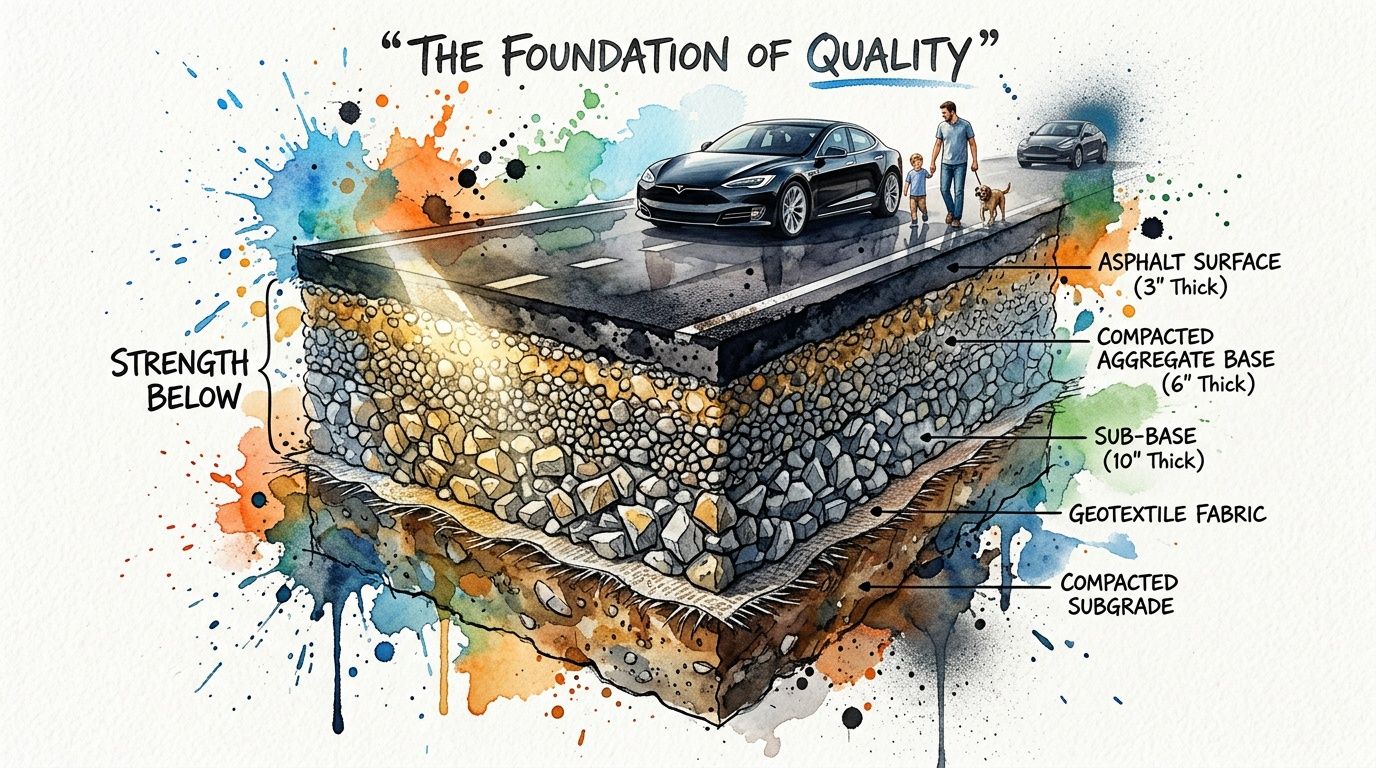
When resurfacing works
Resurfacing can be the right call when the existing base is still structurally sound. According to Jet-Black’s resurfacing cost analysis, asphalt resurfacing costs range from $3 to $10 per square foot, and it can be 30 to 40 percent cheaper than full replacement when the base is solid.
That’s a real savings. But it only applies when the driveway has surface wear rather than structural failure. If the base has deep cracks, movement, or foundation issues, resurfacing is usually money spent on borrowed time.
What fails first underneath
Poor grading is one of the biggest reasons a driveway breaks down early. Water gets into weak spots, the base softens, traffic loads press those areas down, and cracks start reflecting through the surface.
On sloped sites, edge failure often follows. Water moves off the pavement, takes support with it, and the side of the driveway starts raveling or collapsing. This overview of how poor grading wrecks driveways before the asphalt even cracks shows how quickly that cycle starts.
A driveway doesn't fail because the top looked bad. It fails because the support below it stopped doing its job.
What actually protects long-term value
The best value usually comes from matching the repair method to the actual condition of the site. If the base is good, preserve it. If the base is compromised, fix it before paying for finish work.
That approach isn't glamorous, but it works. The asphalt is the wearing surface. The excavation, compaction, grading, and drainage work are what protect the investment.
Saving Money vs Ensuring Long-Term Value
The cheapest proposal isn't always the lowest real cost. A thin overlay can make an old driveway look better fast, and in the right situation that’s a smart move. In the wrong situation, it hides defects for a short period and leaves you paying again when cracks, settlement, or drainage problems return.
A good bid should tell you which condition you're dealing with. If the driveway has isolated surface wear and a stable base, a lighter-scope repair may be justified. If the asphalt is broken because the base is moving, you want that spelled out before work starts.
Where it makes sense to save
Some savings are sensible. Reusing sound base material, limiting demolition to failed areas, or considering recycled asphalt can lower cost without sacrificing the structure if the site supports that approach. For homeowners weighing material choices, this piece on why recycled asphalt is now the standard in California paving is useful background.
Where saving usually backfires
Skipping grading corrections is one. So is paving over standing-water problems or ignoring broken edges that no longer have support. Those shortcuts don't stay hidden for long.
Watch for bids that look thin on prep scope. If the estimate talks a lot about finish appearance and very little about subgrade, base, or drainage, that's a warning sign.
How to compare bids intelligently
Use questions, not just totals.
- Ask what stays and what goes: Is the old pavement being removed, milled, patched, or overlaid?
- Ask what they found below: Did they evaluate base stability, low spots, soft areas, and drainage path?
- Ask how water will move: Where does runoff go once the new driveway is in place?
- Ask what edge support is included: Edges often fail first when they're underbuilt or exposed.
A solid estimate usually reads like a construction plan, not a one-line paving quote.
Frequently Asked Questions About Driveway Repaving
How do I know if I need resurfacing or full replacement?
Look at the type of failure, not just the appearance. If the driveway has light surface wear and the base is still solid, resurfacing may work. If there are deep cracks, sinking areas, repeated potholes, or obvious drainage problems, replacement and base repair are more likely.
Why is my paving quote higher than my neighbor’s?
Driveways that look similar can have very different conditions underneath. Slope, drainage, demolition needs, access, and base failure all change the amount of labor and prep. The paving surface might be the same, but the site work often isn't.
Does drainage really affect the cost to repave driveway asphalt?
Yes. Water is one of the main reasons driveways crack, settle, and lose edge support. If runoff isn't handled correctly, the new asphalt is sitting over a problem that will keep causing damage.
Can a contractor pave over my existing asphalt?
Sometimes. It depends on whether the existing driveway still has a sound base and stable structure. If the old asphalt is badly cracked from movement below, paving over it often means those defects come back through the new surface.
How long does a repaving project usually take?
Timing depends on project size, removal needs, weather, and how much prep work the site requires. A straightforward driveway moves much faster than one that needs grading corrections, drainage work, or excavation before paving starts. The best way to get a realistic schedule is with a site visit.
What should I look for in an estimate?
Look for specific scope. The estimate should explain demolition, grading, base repair, drainage, asphalt installation, and finish details in plain language. If those items are vague, you may not be comparing the same job from one contractor to another.
Get a Clear Estimate for Your Driveway Project
Cost to repave driveway asphalt comes down to one question. Are you paying for a new surface, or are you correcting the site conditions that caused the old one to fail? The answer affects the budget, the lifespan, and whether the work holds up on a flat lot, a hillside driveway, or a drainage-prone property on the California Central Coast.
If you're organizing bids and want cleaner takeoffs for hardscape and site work, tools like Exayard concrete estimating software can help you think more clearly about scope, quantities, and line items before you compare proposals. For an exact number on your property, a site visit is still the right place to start.
If you need a straightforward site assessment for your driveway project, DW Excavation, LLC can help. We work with homeowners across Sonoma County, Monterey County, and the Central Coast to look at the ground conditions first, then build a realistic plan for grading, drainage, and paving preparation. Call (707) 601-9091, visit 470a Caletti Avenue, Windsor, CA 95492, or go to dw-excavation.com to request a free estimate.