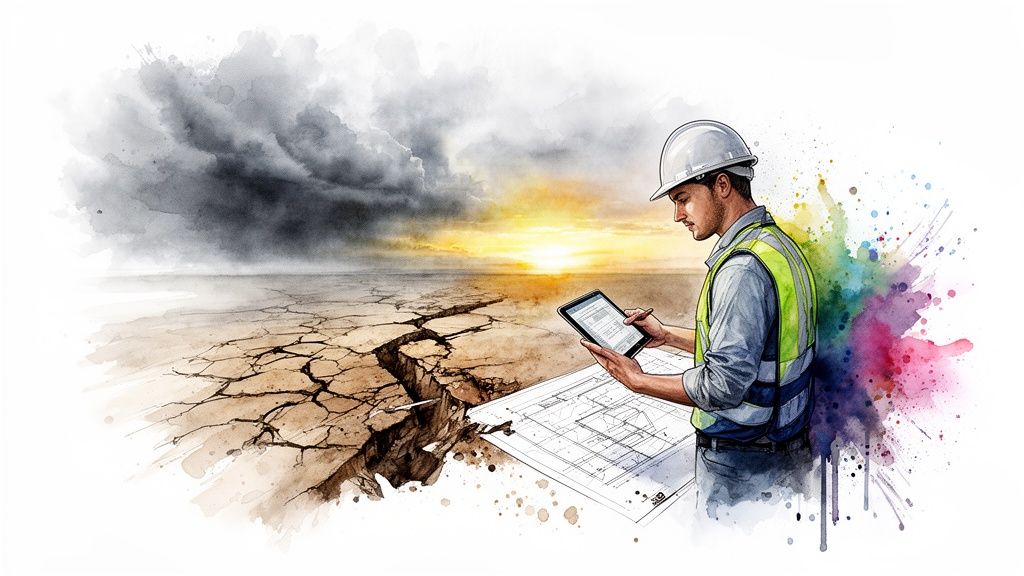
Let’s be honest: new weather patterns are changing site planning forever. The old playbook that assumed predictable rain and stable ground no longer works for building safe, durable structures in California. Today’s world of intense storms, long droughts, and fire risks demands a smarter, more resilient approach right from day one.
The End of Business as Usual in Site Planning
For decades, a site plan was mostly about property lines, zoning rules, and utility hookups. Grading meant scraping a flat spot for a foundation, and drainage was about meeting minimum code. That worked when the weather was consistent, but those days are gone—especially for projects in Sonoma County, Monterey County, or anywhere along the Central Coast.
We are in the middle of a fundamental shift. Market data shows more homeowners and developers are seeking advanced site planning services because extreme weather is exposing grading and drainage failures [FEMA, 2023]. Climate change isn't a future concept; it's actively reshaping how a good contractor must prep a site.
Why Old Methods Fail in Today's Climate
A traditional site plan can become a liability when extreme weather hits. A drainage system designed for a 20th-century storm gets overwhelmed by a modern atmospheric river, leading to flooding and erosion. A foundation plan that doesn’t account for soil cracking during a drought is asking for structural failure.
This new reality is forcing a change in what clients and local governments demand.
- Clients are demanding resilience: Homeowners and developers now ask for storm-resistant grading and climate-smart drainage designs, not just a basic plot plan.
- Counties are tightening regulations: Planning departments scrutinize plans for fire risk, erosion control, and stormwater management.
- Contractors face new risks: Submitting an outdated plan leads to permit delays, costly rework, and a damaged reputation when a site fails its first real-world test.
This shift is so profound that it’s impacting rules far beyond just excavation. The recent ban on direct emission heating systems in new homes signals that "business as usual" is over. It’s forcing a top-to-bottom rethink of how we plan our sites.
Old Site Planning Vs Climate-Resilient Site Planning
| Planning Aspect | Traditional Approach (Outdated) | Climate-Resilient Approach (Essential) |
|---|---|---|
| Drainage | Handle "typical" rainfall; meet minimum code. | Manage extreme storm events; incorporate swales and retention. |
| Grading | Create a flat pad for building. | Shape the land to direct water flow and prevent erosion. |
| Soil Analysis | Basic composition test for load-bearing capacity. | In-depth analysis of soil behavior under drought and saturation. |
| Foundation | Standard slab or perimeter foundation design. | Engineered for soil expansion/contraction and hydrostatic pressure. |
| Fire Risk | Focus on building materials. | Create defensible space and strategic fire breaks during grading. |
| Regulations | Meet historical zoning and code requirements. | Anticipate future climate-driven code changes and standards. |
Yesterday's standards are no longer enough. For a deeper dive into the essentials, check out our guide on what a site plan is and who can help you make one.
How Extreme Weather Exposes Critical Site Flaws
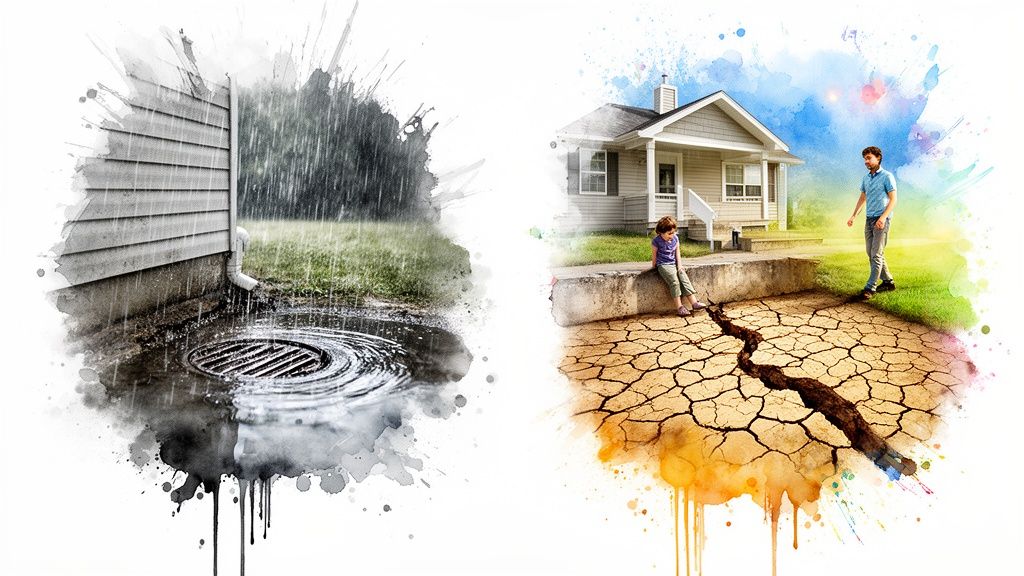
It’s easy to dismiss climate warnings as abstract problems. But for property owners and builders across California, the consequences are tangible, expensive failures. New weather patterns are changing site planning forever by exposing flaws in grading and drainage that were once considered "good enough."
A single intense storm, like the atmospheric rivers hitting Sonoma and Monterey Counties, can dump an entire season's worth of rain in days. For a property with an outdated site plan, that's a recipe for disaster. Drainage systems are instantly overwhelmed, turning yards into lakes and putting immense hydrostatic pressure on foundations.
The result? Thousands of dollars in water damage, landscape erosion stripping away topsoil, and panicked calls to fix a flooded basement. These aren't isolated incidents; they're the direct outcome of site plans not built for today's weather realities.
The Two Extremes Dueling for Your Foundation
The danger isn't just from too much water—it's also from too little. California’s weather now swings violently between massive downpours and prolonged drought, creating a destructive cycle for the ground your structure sits on.
This constant battle between saturation and desiccation puts immense stress on building foundations. A site plan that only addresses one of these extremes—or neither—is fundamentally incomplete.
During long droughts, the clay-rich soils common to the Central Coast shrink and crack. This process, known as subsidence, causes foundations to settle unevenly, leading to cracked walls and sticking doors. With drought conditions becoming more frequent, our soils are consistently drier than before [California Department of Water Resources, 2024].
When heavy rains return, that parched ground can’t absorb water fast enough. You get severe runoff and erosion, while rapid rehydration causes the soil to swell dramatically, pushing upwards against foundation slabs with incredible force.
Common Site Flaws Exposed by Modern Weather
This punishing cycle reveals flaws that might have gone unnoticed for years under milder conditions. Contractors still using old methods are inadvertently setting their clients up for failure.
Here are the most common issues we see:
- Inadequate Grading: A site not properly sloped away from the structure funnels water straight toward the foundation during a downpour.
- Undersized Drainage Systems: Old-fashioned French drains or standard gutters can’t handle the volume of water from modern storms, leading to overflow and saturation.
- Ignoring Soil Behavior: Failing to analyze how local soil expands and contracts is a critical mistake leading to foundations that shift and crack.
- Poor Erosion Control: On hillside properties, especially in Sonoma County, poor grading can lead to landslides and severe soil loss during heavy rains.
These failures translate into costly rework, damaged reputations, and immense stress for homeowners. Learn how a professional grading fix for flood risk can protect your investment before the next storm hits.
The High Cost Of Outdated Site Plans
Ignoring how new weather patterns are changing site planning forever is a major business liability. For contractors and developers in California, sticking to old-school site prep is an increasingly expensive mistake. Failing to adapt means delivering outdated plans that don’t meet new county requirements or climate realities.
The gap between outdated plans and today's climate shows up in costly ways. It's about a site plan getting rejected by a planning department in Sonoma or Monterey because it fails to meet new stormwater rules. That one misstep can halt a project for weeks, torching budgets before a single shovel hits the ground.
The Domino Effect of a Flawed Plan
An outdated site plan creates a domino effect of failures that can tank a project's profitability and a contractor's reputation. The consequences ripple outward, growing more severe and expensive with each step.
Here’s how that failure typically unfolds:
- Permit Rejection: Your plan is denied because it doesn’t address modern requirements for erosion control or fire-defensible space, leading to costly redesigns.
- Post-Build Failures: The first significant storm reveals every flaw. Inadequate grading leads to foundation flooding, and the client’s landscape washes away.
- Expensive Rework: You're now on the hook for repairs after construction is finished, such as re-grading the property or installing a new drainage system.
- Damaged Reputation: The final cost is the most damaging. Unhappy clients and negative reviews make it harder to win bids against competitors who are building for the real world.
A site plan is a promise to the client that their investment is safe. When that plan fails to account for real-world climate risks, it breaks that promise and puts the contractor's entire business at risk.
Bridging the Knowledge Gap to Protect Your Bottom Line
The core problem is a knowledge gap. Many contractors are experts at execution but haven't updated their planning process for today's volatile weather. To learn more, read our article explaining if poor grading can really damage my foundation or driveway.
This is where a partnership with an engineering-minded expert becomes essential. At DW Excavation, we bridge that gap by assessing slope, soil, and drainage needs during the initial planning phase. We specialize in proactive, climate-smart site plans that satisfy strict county regulations and protect your bottom line.
Building a Future-Ready Site Development Playbook
To build for the long haul, you must accept that the old playbook for site development is broken. Adapting to our changing climate demands a new strategy. A future-ready plan goes beyond minimum building codes to create resilient properties that can handle whatever nature throws at them.
New weather patterns are changing site planning forever, turning yesterday's best practices into today's risks. At DW Excavation, our engineering-integrated approach is built for this new reality. We engineer the land for decades of stability, considering how intense rain and drought will impact a site long after we're gone.
Climate-Smart Grading for Erosion Control
On the hillsides of Sonoma and Monterey Counties, just carving a flat pad into a slope is asking for trouble. We practice climate-smart grading to shape the land thoughtfully. The goal is to slow down, absorb, and safely guide water away during intense downpours.
Instead of fighting the land's natural contours, we work with them.
- Creating Gentle Contours: We avoid sharp, steep slopes that act like a waterslide for soil and instead create gentle contours to help water lose destructive energy.
- Engineering Swales and Berms: These are strategically placed to guide water away from foundations and keep topsoil where it belongs.
- Preserving Natural Vegetation: Existing plant roots act like nature’s rebar, holding the soil together better than anything we could build.
This transforms a property from a liability into an active part of the water management solution.
Advanced Drainage Systems for Intense Rainfall
The drainage systems of the past weren't built for the atmospheric rivers that now hit the California Central Coast. A modern playbook must include advanced drainage solutions designed to handle huge volumes of water without failing. It's about building in redundancies so your property stays dry.
Our approach combines several key components:
- High-Capacity French Drains: We engineer larger, deeper systems to move massive amounts of subsurface water away from your foundation.
- Permeable Surfaces: For driveways and walkways, we often recommend permeable pavers or specialized gravel to allow rainwater to soak into the ground.
- Strategic Stormwater Management: On larger sites, we design systems like catch basins and underground retention tanks to manage runoff responsibly.
You can dive deeper into our methods in our guide to water management services on the California Central Coast.
Relying on outdated plans that ignore these modern strategies can have seriously expensive consequences.
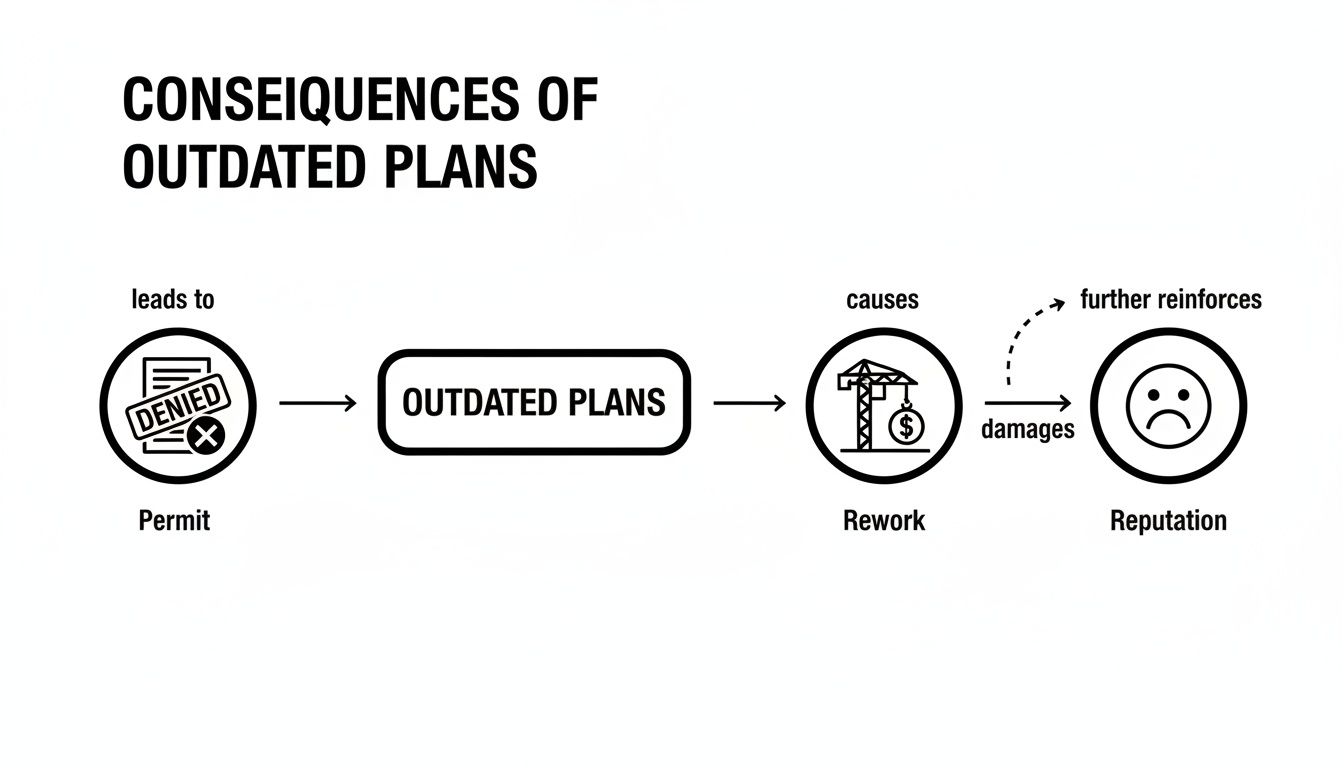
As you can see, poor planning leads directly to permit denials, costly rework, and a damaged reputation. A proactive, resilient design helps every contractor avoid this painful cycle.
Foundations Engineered for Volatile Soil
California’s cycle of drought and deluge is incredibly tough on soil. A standard-issue foundation isn't built to handle that kind of movement year after year. Our engineering-first approach means we design foundations specifically for the volatile soil conditions found in our region.
It starts with a detailed geotechnical analysis. From there, we might implement solutions like reinforced concrete, deeper footings, or integrated moisture barriers. The goal is to create an unshakeable base that resists shifting, cracking, and water intrusion.
Building for the future means acknowledging that urban areas face disproportionate climate impacts. Incorporating green spaces and permeable paving is no longer optional but essential for community resilience. Discover more insights about how urban green spaces combat climate change from the USDA.
Building resilient sites means getting granular with planning. A solid playbook should include tools like Exayard landscape takeoff software to accurately map and manage critical components. By pairing intelligent design with rock-solid engineering, we ensure your structure's foundation is built to last.
Navigating Regulations In California's High-Risk Zones
Building in Sonoma and Monterey Counties has gotten tougher. Local governments are adapting regulations to a climate that’s throwing curveballs—from intense wildfires to historic flooding. Gone are the days of simple permit approvals, especially for projects in high-risk zones.
Today, planning departments are putting site plans under a microscope. They’re demanding proactive solutions for problems that used to be an afterthought. If your plans don't clearly address modern threats like extreme stormwater runoff and fire-defensible space, you can guarantee a long wait.
Case Study: An ADU on a Sloped Sonoma Property
Let’s look at a classic Sonoma County project: building an Accessory Dwelling Unit (ADU) on a sloped, wooded lot. A few years ago, the main concerns would have been property line setbacks. Not anymore.
Today, the review process is far more intense, a direct reflection of how new weather patterns are changing site planning forever.
A site plan that gets approved today has to go way beyond the basics:
- A Real Fire-Defensible Space Plan: This is a multi-zone strategy for managing vegetation and guaranteeing emergency vehicle access, baked into the initial grading plan.
- Serious Erosion Control for the Rainy Season: The plan must show exactly how the site will handle an atmospheric river event with detailed specs for silt fences and swales.
- Advanced Stormwater Management: The county wants to see a fully engineered system designed to handle a massive volume of runoff, not just a simple French drain.
Navigating this tangled web of changing regulations requires deep local knowledge. A contractor who knows what the Sonoma County Planning Department is worried about can design a plan that answers their questions before they even ask them.
Why Local Expertise Is Your Best Advantage
Getting permits in high-risk areas is about proving your site is resilient. At DW Excavation, our years of experience in Sonoma and Monterey Counties mean we know what regulators are looking for. We don’t wait for them to send back a list of problems—we build plans that solve those problems from day one.
By integrating fire-defensible space, erosion control, and smart drainage into the core site plan, we help you skip the costly back-and-forth that stalls so many projects. This approach delivers a safer, more durable site for the long haul.
Partnering With DW Excavation For a Resilient Future
The writing is on the wall: new weather patterns are changing site planning forever. Sticking to the old playbook is a direct threat to your project's budget, timeline, and professional reputation. For contractors and developers in California, the choice is simple: adapt or risk getting left behind.
Partnering with an expert transforms this challenge into a competitive advantage. At DW Excavation, we deliver future-ready site plans designed to anticipate extreme weather, satisfy tough local regulations, and protect your investment. This proactive strategy is what separates a successful project from one riddled with costly callbacks.
From Liability to Advantage
Choosing to build for resilience means your project will breeze through inspections. Our plans are designed to meet the heightened scrutiny of planning departments in Sonoma and Monterey Counties. More importantly, it means happier clients who won't be calling you in a panic after the first big storm.
A resilient site plan builds your most valuable asset: a reputation for quality and reliability. When you consistently deliver projects that withstand California's climate challenges, you attract better clients and earn the kind of referrals that build a business.
Build Smarter From The Ground Up
If you're planning projects in Sonoma or Monterey County, now’s the time to upgrade your site planning approach. Don't let an outdated site plan undermine your next project. Partner with DW Excavation to build smarter from the start.
If you're ready to build safer and more resilient projects, it’s time to talk. Learn more about our comprehensive DW Excavation services and contact our team today to start planning for a resilient future.
FAQs About Climate-Resilient Site Planning
Here are answers to the most common questions we hear from homeowners and contractors about adapting to California’s new climate reality.
Why is soil so important for site planning now?
California's extreme weather swings cause soil to constantly expand (when wet) and contract (when dry). This movement puts immense stress on a foundation, leading to cracks, settling, and long-term structural damage. A modern site plan must analyze and account for this soil behavior to ensure a stable build.
What is the biggest mistake contractors make with drainage today?
The most common mistake is installing undersized systems designed for "average" rainfall. Today’s atmospheric rivers can overwhelm old-fashioned French drains and standard gutters. A resilient site needs a high-capacity drainage system engineered to manage extreme water volume and prevent catastrophic flooding.
How does resilient site planning affect my project's budget?
While a climate-resilient site plan may have a higher initial investment, it prevents far more expensive problems down the road. It helps you avoid the high costs of permit delays, post-build flood repairs, foundation fixes, and landscape restoration. Think of it as insurance against climate-related disasters.
What are 'defensible space' requirements in Sonoma County?
Defensible space is a mandated buffer between a building and the surrounding wildland to slow or stop the spread of wildfire. In high-risk areas like Sonoma County, site plans must include a detailed strategy for vegetation management, clearing, and creating access for emergency vehicles, all integrated into the initial grading plan.
Can a good site plan really prevent erosion on a sloped lot?
Absolutely. A key part of future-ready site planning is climate-smart grading. Instead of just creating a flat pad, we shape the land with strategic contours, swales, and berms. This slows water down, prevents soil from washing away, and protects both your property and your neighbors' during heavy rain events.
Ready to build a site that's prepared for California's future? The team at DW Excavation, LLC specializes in engineering-integrated site planning that protects your investment from the ground up. Contact us today to discuss your project and learn how our expertise can ensure a resilient, high-performing result.