Working on a construction project on the California Central Coast means dealing with a unique weather challenge. Our climate doesn't do “average.” Instead, we swing wildly between intense winter downpours and long, bone-dry summers.
This “feast or famine” water cycle is the single biggest factor influencing grading and drainage design in our region. Standard, one-size-fits-all grading practices simply don’t work here; they fail to handle both massive runoff from an atmospheric river and the soil-hardening realities of a prolonged drought. Getting it wrong leads to foundation damage, erosion, and expensive project failures.
The Unique Weather Challenge on the Central Coast
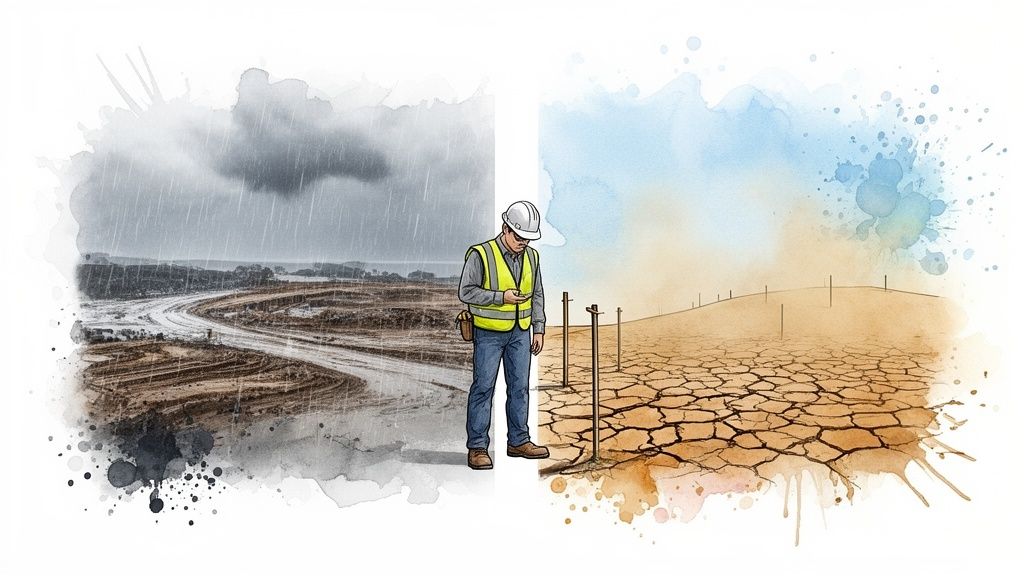
Building here is like preparing a site to survive both a flood and a drought in the same year. One season brings torrential rains that turn the ground to soup, while the next can go months without a drop, causing soil to bake, crack, and shift.
This dramatic swing defines our local climate. Historical data shows just how extreme it can get, with statewide annual precipitation records jumping from a low of 10.75 inches to a high of 42.82 inches [WRCC]. For properties in Monterey and San Luis Obispo Counties, this means a powerful winter storm could dump over 50 inches of rain on coastal hillsides, while a town miles inland gets less than half that.
Why Does Central Coast Weather Matter for Your Project?
This constant back-and-forth between soaking wet and completely dry creates critical challenges that generic grading plans miss. A design based on "average" rainfall will be overwhelmed during an atmospheric river, leading to uncontrolled runoff, serious erosion, and potential flooding.
On the flip side, a drainage system not built to survive a long dry spell can get clogged with hardened sediment, making it useless when rains return.
The consequences are severe and costly:
- Foundation Damage: When water has nowhere to go, it pools against your structure. This oversaturates the soil, causing it to expand and put immense pressure on foundation walls, which can lead to cracks and structural failure.
- Failed Inspections: County inspectors in places like Monterey and Sonoma know these weather risks. A grading and drainage plan that doesn't account for peak water flow and erosion control will be rejected, causing major delays.
- Costly Rework: Fixing a failed drainage system, a washed-out slope, or a cracked foundation is exponentially more expensive than doing it right the first time. It often means re-excavating huge portions of your property.
To give you a clearer picture, here’s a quick breakdown of how our weather translates directly into project risks.
Central Coast Weather vs. Project Risk
| Weather Event | Impact on Soil and Terrain | Primary Grading and Drainage Risk |
|---|---|---|
| Atmospheric Rivers | Extreme soil saturation, flash runoff on hillsides, and mudflows. | Overwhelmed drainage systems, severe erosion, and foundation flooding. |
| Prolonged Droughts | Soil hardens, cracks, and becomes hydrophobic (repels water). | Initial rainfall runs off instantly, overwhelming systems not designed for flash flow. |
| Seasonal Swings | Rapid expansion (wet) and contraction (dry) of clay-heavy soils. | Soil instability, foundation settling or heaving, and cracked retaining walls. |
| El Niño/La Niña Cycles | Unpredictable periods of either extreme wet or extreme dry conditions. | Standard "average" designs fail under both scenarios, leading to system failure. |
Successfully navigating these conditions isn’t about guesswork; it requires deep, localized knowledge of how the land and weather interact. As California Central Coast excavation experts, we know a resilient project is one designed for the extremes, not the averages.
Why Generic Grading Plans Fail on the Central Coast
Residents of Monterey County know that when heavy rains hit during winter, steep lots and poorly graded sites can turn into flooding hazards overnight. A generic grading strategy isn't just a bad idea—it's a recipe for disaster.
The Central Coast's microclimates—from foggy Carmel to inland Salinas—make planning even trickier and demand a customized approach. Many contractors overlook drainage slope calculations or don’t factor in Monterey’s seasonal water runoff, leading to foundation issues, erosion, or failed inspections.
What are the Hidden Risks of Expansive Clay Soils?
One of the biggest culprits behind foundation failure in our area is expansive clay soil. Think of it like a giant sponge under your property. It swells dramatically when soaked with winter rain, then shrinks and cracks open during our long, dry summers.
This constant cycle of expanding and contracting creates powerful ground movement. A generic grading plan doesn't account for this instability. When the ground under a new building pad heaves and settles, it puts immense stress on the foundation, leading to cracks, sloping floors, and doors that won't close. You can learn more about why this matters in our guide to what a building pad is.
What Happens When Slope Calculations Go Wrong?
Improper slope calculation is another common mistake. A contractor might grade a site with a minimal slope, thinking it’s enough for drainage. But this often fails to account for the sheer volume and velocity of water during a peak storm.
The results are predictable and devastating. We’ve been called to countless projects where inadequate slopes led to:
- Backyard Flooding: Water pools in low spots, turning yards into muddy swamps and destroying landscaping.
- Foundation Saturation: Runoff is channeled right toward the house, saturating the soil around the foundation.
- Erosion and Washouts: Uncontrolled water flow carves deep gullies, washing away topsoil and undermining driveways or retaining walls.
Poor local planning can hurt rankings and online reviews—especially when angry homeowners post photos of flooded backyards.
Community Insight: Homeowners in Monterey and Salinas often search for grading and drainage contractors after a heavy rain—especially during January–March. We’ve seen spikes in emergency-related queries and permitting requests during “atmospheric river” events.
How Do Intense Storms Impact Drainage?
The failure of standard drainage really shows during our region's intense, short-duration downpours that completely overwhelm undersized systems. Data shows that our steep coastal watersheds can produce severe flooding from just one or two days of heavy rain [USGS].
The problem is worse in post-wildfire burn areas, where runoff can increase by up to 400% [USGS, 2018]. During one of California’s wettest years, Central Coast weather stations recorded 110-150% of their normal precipitation. That same year, 15-20% of new residential grading projects had to be reworked due to subsidence and drainage failure. This proves that standard designs are not built for our weather extremes, a fact you can explore by reading about California's unique precipitation patterns online.
Ultimately, local expertise is a necessity. DW Excavation understands Monterey County’s terrain, permitting rules, and grading regulations. We design sites that can handle the water and erosion challenges of the future.
Building Resilient Sites With Engineering-Integrated Grading
Surviving the Central Coast's volatile weather isn't about luck—it's about smart engineering. An engineering-integrated approach goes beyond moving dirt. It's about building a site for the absolute worst-case scenario, using data and foresight to create a solid foundation.
This philosophy is where old-school excavation expertise meets modern engineering principles. We ask tough questions long before the first scoop of soil is moved. How will this specific clay soil react during a three-day atmospheric river? What's the maximum water runoff we can expect during a 100-year storm?
How Do You Plan for Peak Storm Events?
Standard grading often plans for "average" rainfall, which is a massive mistake here. Our process starts by calculating runoff coefficients based on peak storm data. This tells us exactly how much water will pour across a property during an extreme weather event.
With this data, we can design drainage systems that are up to the task. This often includes systems like:
- High-Capacity French Drains: These are engineered to capture and channel huge volumes of subsurface water away from foundations before it can build up hydrostatic pressure.
- Engineered Swales: We design carefully graded, vegetated channels that slow down, absorb, and safely redirect surface water to prevent erosion.
A key part of this is creating stable ground from the start. It’s not just about grading; it’s also about knowing what soil stabilization is and how it protects your property.
What is the Role of Technology in Modern Grading?
Guesswork has no place in modern site development. Today, we rely on advanced technology to ensure every cut and fill is executed with millimeter precision. This proactive, data-driven method is what separates a durable site from one doomed to fail.
GPS-guided equipment allows our operators to follow a digital site plan with incredible accuracy, eliminating human error. We also use drone mapping to create detailed topographical surveys before, during, and after a project, giving us a complete picture of the site's hydrology.
This table shows the difference between a typical approach and our engineering-integrated method.
| Feature | Standard Grading Approach | Engineering-Integrated Approach (DW Excavation) |
|---|---|---|
| Initial Planning | Based on visual assessment and average conditions. | Based on soil reports, peak storm data, and hydrological modeling. |
| Drainage Design | Installs generic systems like basic French drains or swales. | Designs custom-sized drains and swales engineered for 100-year storm events. |
| Equipment | Relies on operator experience and manual stakes. | Uses GPS-guided equipment for millimeter-level accuracy. |
| Soil Management | Moves dirt from Point A to Point B. | Includes soil stabilization and mandatory compaction testing. |
| Goal | Achieve a level pad and basic drainage. | Build a resilient site that actively manages water and prevents future issues. |
Ultimately, this level of precision prevents problems before they can start.
The flowchart below shows what happens when engineering principles are ignored—a common outcome with generic, one-size-fits-all plans.
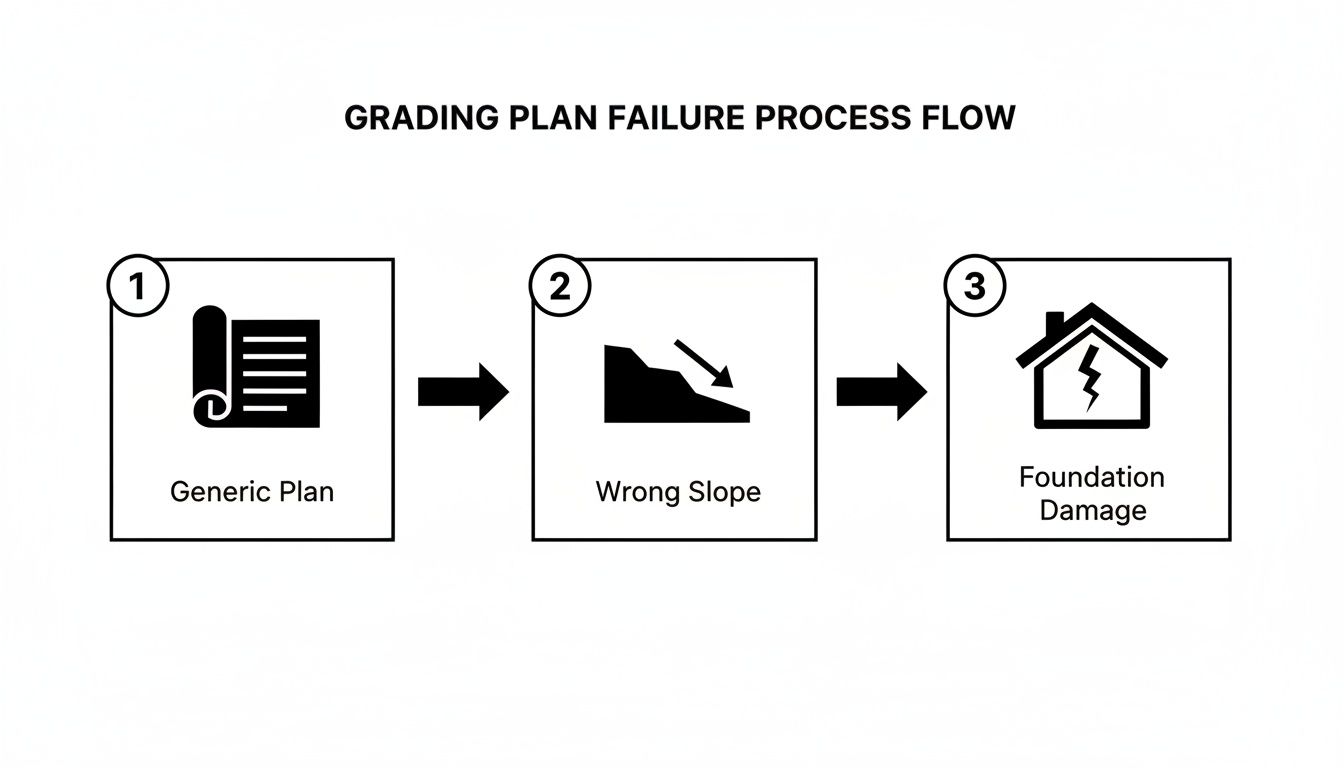
As you can see, a flawed plan directly leads to incorrect slopes and, eventually, to serious and expensive structural damage.
Why is Compaction Testing a Non-Negotiable Step?
One of the most critical parts of engineering-integrated grading is soil compaction testing. After soil is placed, it must be compacted to a specific density to provide a stable base. Inadequate compaction is often the root cause of foundation settling and cracking.
On the Central Coast, this step is doubly important. Our clay-heavy soils hold a ton of moisture. If not compacted correctly when dry, they will compress unevenly when the winter rains hit, leading to subsidence and structural stress.
We conduct rigorous compaction tests to verify that the soil meets or exceeds engineering requirements. This ensures the building pad and other critical areas will remain solid through countless wet-dry cycles.
This attention to detail is fundamental. To dive deeper, check out our article on integrating erosion control and water management solutions for sustainable landscaping. By combining smart design, modern tech, and rigorous testing, we build sites ready for anything the Central Coast weather can throw at them.
Smart Project Scheduling to Avoid the Rainy Season
Timing is everything on the California Central Coast. A poorly timed grading project can easily turn into a muddy, expensive mess, leading to blown budgets, failed inspections, and long-term structural problems. The smartest approach is to work with our climate, not against it.
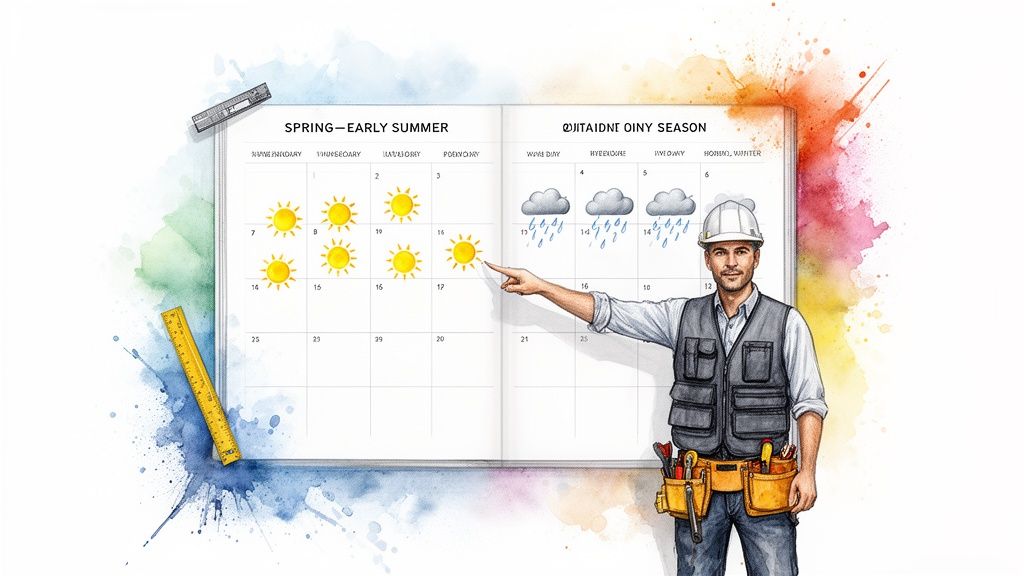
Kicking off your grading and drainage work in late spring or early summer is the single best move to avoid weather-related headaches. During these months, the soil is stable, predictable, and easy to work with. This allows crews to achieve precise grades and the proper soil compaction needed for a rock-solid foundation.
What Are the Challenges of Winter Construction?
Trying to do major grading during the rainy season—typically from November through March—is asking for trouble. Wet soil is a beast. It's incredibly heavy and sticky, making it far more difficult and time-consuming to move, driving up labor and fuel costs.
The biggest risk is failing to achieve proper compaction. Saturated soil is like a wet sponge; you can't compress it. Building on improperly compacted ground is a surefire way to end up with foundation settling and cracking.
Beyond the dirt itself, winter work brings other headaches:
- Permitting Delays: Local agencies in Monterey and Sonoma counties often pause permit approvals and inspections during big storms. A single atmospheric river can sideline your project for weeks.
- Increased Erosion Risk: Disturbing soil when it's pouring rain dramatically increases the risk of erosion and sediment runoff, which can lead to hefty fines.
- Safety Hazards: Muddy, slippery job sites are dangerous and make operating heavy equipment much riskier.
How Can Strategic Scheduling Ensure Success?
A well-planned project timeline uses the dry season for all critical site prep. We urge clients to start their site planning and grading work early in the dry season to get ahead of winter slowdowns. For a deeper dive, check out our guide on expert grading tips before the rain hits.
Practical Tip: Contractors should plan ahead for winter permitting delays. Start your site planning and grading work early in the dry season (spring–early summer) to avoid weather-related slowdowns and increased labor costs from working wet soil.
By getting excavation, grading, and underground utilities installed before the first big storms arrive, you create a stable, well-drained site. This proactive approach saves time and money and protects your investment against the forces of Central Coast weather.
Navigating Central Coast Permitting and Regulations
Proper grading and drainage on the Central Coast isn't just about good site work; it's about navigating a tricky maze of local rules. Counties like Monterey and Sonoma have incredibly strict regulations designed to manage stormwater and control erosion, especially on sensitive coastal slopes.
Bypassing these rules is a fast track to stop-work orders, fines, and project-killing delays. An out-of-area contractor might not realize a grading plan for a foggy Carmel slope has completely different requirements than one for an inland Salinas floodplain. Getting these local details right is key to getting plans approved.
Why Are Local Regulations So Strict?
The main reason is the Central Coast’s intense winter storms. When heavy rains hit, uncontrolled runoff from a new construction site can cause a cascade of downstream problems like flooding, polluted waterways, and erosion.
Because of this, local planning departments scrutinize every grading plan. They look for compliance with regulations like:
- Stormwater Management Rules (MS4 Permits): Federal and state mandates forcing projects to prevent pollutants from washing into local storm drains and creeks.
- Erosion Control Mandates: During construction, exposed soil must be protected with measures like silt fences, fiber rolls, or hydroseeding.
- Hillside Ordinances: Projects on steep slopes require detailed geotechnical reports and much beefier drainage systems to prevent landslides.
If your plan doesn't meticulously address these points, it will be rejected, sending you back to the drawing board.
What is the Cost of a Failed Inspection?
It’s easy to underestimate how much a failed inspection can derail a project. A stop-work order can halt all activity on your site for weeks or months, creating a domino effect of expensive problems.
A failed grading inspection often triggers a full review of your project's engineering, potentially leading to a complete redesign of the site plan. This means new engineering fees, resubmission costs, and a significant blow to your timeline and budget.
This is where local experience is a game-changer. We’ve completed projects across coastal slopes, inland flood zones, and agricultural buffer areas, always designing for future water movement and erosion control. We design grading and drainage systems that are compliant from day one. It's always easier when you have a clear blueprint, which is why we stress understanding what a site plan is and who can help create one.
A Partner Who Understands the Process
Getting through Central Coast permitting requires relationships and a proven track record. By demonstrating a deep understanding of local water movement, soil types, and regulatory hot buttons, we build trust with permitting agencies. That trust helps get our plans approved faster.
For contractors and homeowners, this means less stress and fewer nasty surprises. Instead of battling regulators, you can move forward with confidence, knowing your site is engineered to be safe, stable, and fully approved.
Building for the Central Coast: Why Local Knowledge Matters
If there's one thing that defines building on the California Central Coast, it's this: you have to respect the weather. Our unique cycle of torrential winter downpours followed by long, bone-dry summers creates a massive challenge. A generic, one-size-fits-all grading and drainage plan is a recipe for disaster.
The consequences of getting this wrong are serious. Contractors who miscalculate drainage slopes or ignore Monterey’s seasonal runoff patterns end up causing foundation damage, runaway erosion, and failed county inspections. A dream project can quickly become a long-term headache.
Why is Local Expertise Essential?
This is where having an engineering-focused team makes all the difference. We don’t just move dirt; we use deep local knowledge and technical precision to build a strategic defense against the elements. It’s about preparing a site for a 100-year storm, not just an average afternoon.
At DW Excavation, we live and breathe this stuff. We know the tricky terrain, the complex permitting maze, and the specific grading rules that govern projects from Sonoma down to Monterey County. Our entire focus is on planning for future water movement and creating erosion control that actually works.
Don’t let predictable weather cause preventable problems. If you're a contractor working in Monterey, Salinas, or anywhere along the Central Coast, let DW Excavation help you avoid the drainage mistakes we see every rainy season. We’re here to help your sites stay solid—rain or shine.
Frequently Asked Questions About Central Coast Grading
Here are answers to common questions about grading, drainage, and building sites that can stand up to anything Monterey and Sonoma counties throw at them.
1. How much slope is needed for proper drainage in California?
Most residential lots in Monterey and Sonoma counties need a minimum 2% slope away from the foundation for at least the first 10 feet. For hard surfaces like a driveway or patio, a 1% slope is usually enough to prevent pooling. However, just meeting the minimum isn't always enough here. We often engineer steeper slopes to ensure massive water volume from an atmospheric river is carried away quickly.
2. Can grading work be done during the winter?
We strongly recommend against significant grading during the rainy season (November through March). Wet soil is heavy, messy, and nearly impossible to compact correctly. Trying to grade in wet conditions usually leads to project delays, higher costs, and a weak foundation pad that’s likely to fail inspection. For best results, plan major grading for the dry season.
3. What is the difference between grading and drainage?
Think of it like this: grading is sculpting the land, while drainage is managing the water that runs over it. For a site to be resilient, these two must work together perfectly.
- Grading creates the right slopes and contours to guide water away from buildings.
- Drainage refers to the systems (French drains, swales, catch basins) that collect and channel that water safely off your property.
A great drainage system won't help on a poorly graded lot. Understanding what groundwork in construction involves helps clarify how these two elements come together.
4. How do I spot a drainage problem on my property?
Drainage problems often leave clues, especially after a hard rain. Look for these warning signs:
- Standing Water: Puddles near your foundation that remain more than 24 hours after a storm are a red flag.
- Visible Erosion: Small channels or ruts forming on slopes indicate soil is being washed away.
- A Soggy Yard: If parts of your lawn are always muddy, it points to a subsurface drainage issue.
If you spot these issues, your property needs a professional assessment to prevent long-term damage.
5. Why is a local contractor so important for grading in Monterey County?
Local contractors bring essential knowledge that out-of-area firms lack. We understand the specific soil types (like expansive clay), microclimates from Carmel to Salinas, and complex county permitting rules. This expertise prevents common mistakes that lead to erosion, foundation damage, and failed inspections, saving you time and money in the long run.
If you're a contractor working in Monterey, Salinas, or anywhere along the Central Coast, let DW Excavation help you avoid the drainage mistakes we see every rainy season. We’re here to help your sites stay solid—rain or shine. Learn more at https://dw-excavation.com.