If you're a property owner in California, there's a fundamental shift in site planning you need to know about: the days of “build now, fix later” are completely over.
With intensifying climate risks and stricter local regulations, proactive site planning is no longer just a good idea—it's mandatory. Failing to adapt to these new expectations can lead to permit denials, flood damage, and costly rework.
The New Reality: Why Past Methods Fail Today
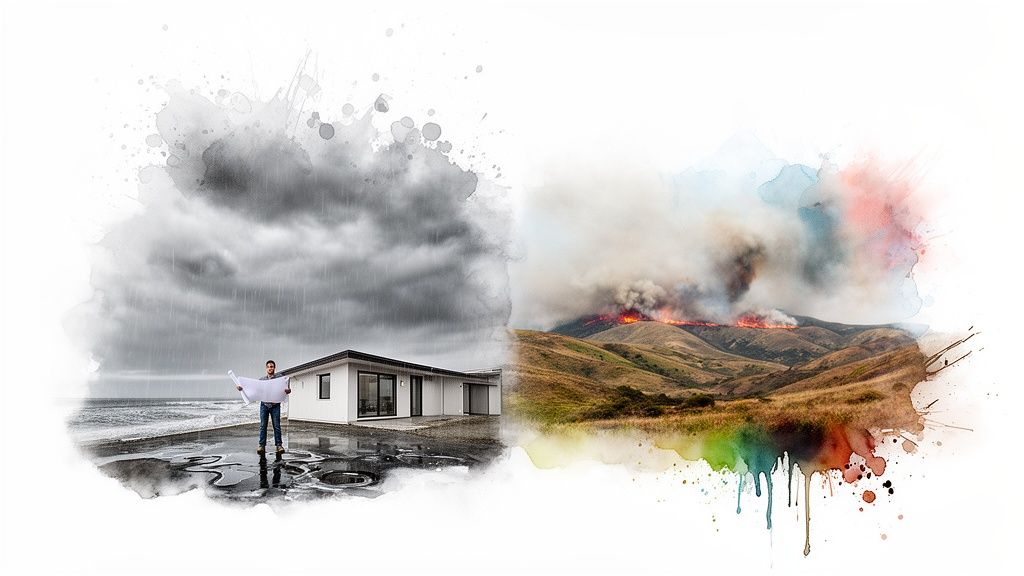
For decades, many property owners in California could get by with a basic site plan, treating grading and drainage as afterthoughts. That old approach is now a serious liability.
The ground has shifted, both literally and in the eyes of regulators. Extreme weather isn't an "if" anymore; it's a "when." In fire-prone areas like Sonoma County and the flood-prone regions around Monterey County, local governments have slammed the door on old practices.
What Regulators Expect from Property Owners Now
What was once "good enough" for a building permit will get your plans rejected today. Homeowners and small-scale developers are now required to show professional strategies for:
- Drainage and Stormwater: You must prove exactly where rainwater will go and show it won’t flood neighbors or cause erosion.
- Defensible Space: Grading the land to create a critical buffer zone is now required to help protect your property from wildfires.
- Slope Stability: On a hillside, you need to guarantee that excavation and grading won't cause a landslide during the next big storm.
This new standard impacts every project, from a custom home to a small backyard ADU. Failing to get this right is one of the biggest reasons we see for permit denials and costly rework. Unsure if your project needs this level of detail? Check out our guide to see if you need a site plan even for a small project.
Site Planning Then vs. Now: A Homeowner's Guide
This table highlights the key differences between outdated site planning approaches and today's required standards, helping property owners understand what has changed.
| Planning Element | The Old Way (Pre-Shift) | The New Standard (Today's Reality) |
|---|---|---|
| Drainage | Basic swales, assumed runoff would "find its way." | Engineered bioswales, retention basins, and detailed runoff calculations are now required. |
| Fire Safety | Minimal brush clearance, often an afterthought. | Mandated defensible space, specific grading for fire truck access, and fire-resistant landscaping. |
| Erosion Control | Hay bales and silt fences were often the only measures. | Multi-layered strategies including hydroseeding, geotextiles, and retaining walls are common. |
| Permitting | Simple plot plan often sufficed for approval. | Requires a comprehensive grading and drainage plan signed by a licensed professional. |
| Technology | Manual surveys with tape measures and transit levels. | GPS, drones for topographical mapping, and advanced software for modeling water flow. |
| Primary Goal | Get the structure built as quickly and cheaply as possible. | Build a resilient, compliant property that is safe, insurable, and holds long-term value. |
As you can see, the bar is much higher. Simply "moving some dirt around" is no longer a viable strategy.
The Financial and Regulatory Impact of Ignoring the Shift
Sticking to outdated methods has severe consequences. Extreme weather events now expose weaknesses in over 70% of U.S. construction sites, with flood damage alone costing the industry billions annually [Associated General Contractors of America, 2023].
Here in California, state regulations now mandate serious erosion control and stormwater management in 85% of new residential developments [California Water Boards, 2022]. This is a massive jump from the 1990s when only about 20% of sites had to address drainage proactively.
The core problem is that many contractors haven’t kept up with these evolving regional codes. They use old-school methods that lead straight to failed inspections, leaving property owners with frustrating and expensive fallout.
Navigating the complex world of permits and zoning is more challenging than ever. While tools like BIM for land use regulations can offer a guide, nothing replaces hands-on expertise. DW Excavation specializes in creating compliant, climate-ready site plans that anticipate these modern requirements.
Why Your Old Site Plan Is Now a Liability
Ignoring the shift in site planning every property owner should know isn’t just a bad idea—it’s a direct liability. Imagine spending months planning your dream ADU, only to have the county planning department reject your plans flat out.
The gap between old-school building habits and today’s strict requirements is widening, especially in fire-prone areas like Sonoma County and flood-vulnerable regions like Monterey County. What worked a decade ago is now a recipe for denial.
The High Cost of Outdated Planning
Relying on an old site plan can turn your exciting project into an expensive nightmare. Contractors who aren't current on local codes often produce plans that look good on paper but crumble under scrutiny, leading directly to permit denials.
Even worse are projects that sneak through approvals but are built on a flawed foundation. An inadequate drainage strategy might seem fine at first but can lead to a flooded crawl space or a cracked foundation. You can learn more about how poor grading can really damage your foundation or driveway in our detailed guide.
A rejected permit isn't just a piece of paper; it’s a symptom of a much bigger problem. It’s a red flag that your contractor may not grasp the modern liabilities of erosion, stormwater runoff, and fire safety that California regulators now take so seriously.
From Minor Setback to Major Rework
When an outdated plan fails, the consequences ripple through the entire project. We often see a contractor do a basic "cut and fill" grading job, assuming it’s good enough. Then the first big winter storm hits.
Now you're on the hook for expensive rework and potentially liable for damages. This is where the real cost of improper planning hits home. The painful process usually involves:
- Emergency Interventions: Scrambling to hire experts to mitigate immediate water damage or stop erosion.
- Costly Redesigns: Paying engineers to draw up a new, compliant grading and drainage plan from scratch.
- Permit Re-Submissions: Going back through the county's review process a second time, adding months to your timeline.
- Corrective Excavation: Hiring a new crew to re-grade the entire site, install proper drainage, and fix any damage.
This is the new reality on the Central Coast—planning for resilience isn't optional. At DW Excavation, we specialize in creating site plans that meet today’s standards, ensuring your project is built to withstand tomorrow’s storms with confidence.
The Four Pillars of Climate-Ready Site Planning
To keep up with the shift in site planning every property owner should know, a modern, resilient site plan must be built on four essential pillars. Think of these as the foundation for your foundation—get them right, and your entire project becomes stronger and safer.
These pillars aren't just separate tasks; they work together to create a unified strategy that deals with today's climate realities and regulatory demands. It’s a move away from the old "good enough" approach toward a new standard for responsible construction.
1. Advanced Drainage and Stormwater Management
Controlling water is the cornerstone of modern site planning. With atmospheric rivers becoming the new normal, your property has to handle a massive volume of stormwater without flooding or eroding.
This requires a true engineering mindset and includes:
- Calculated Runoff Control: We precisely calculate how much water your site will receive, then design systems like bioswales or French drains to manage it safely.
- Erosion Prevention: This involves using strategic grading and ground cover to slow water flow, stopping it from washing away valuable topsoil.
- Protecting Structures: The goal is to direct every drop of water away from your foundation and driveway to prevent cracks and long-term water damage.
A professional grading fix for flood risk can make all the difference in protecting your investment.
2. Defensible Space and Fire-Resilient Grading
In wildfire country, how you shape your land is as critical as how you build on it. Defensible space—the buffer zone between a building and wildland—is a non-negotiable part of any site plan today.
Fire-resilient grading is about creating strategic fuel breaks and guaranteeing access for emergency vehicles. A properly graded site can slow a fire's advance and give firefighters a crucial advantage, making your property safer and more insurable.
Today's site plans must show a clear, deliberate strategy for fire mitigation. Local fire marshals and planning departments now review grading plans specifically for defensible space compliance. A weak plan is a guaranteed rejection.
3. Precision Grading with GPS Technology
Whether you're creating a slope for drainage or a pad for a building, you need absolute precision. Old methods using stakes and string just don't cut it anymore for meeting today’s tight engineering tolerances.
GPS-guided grading equipment allows our operators to sculpt the land with sub-inch accuracy. By following a digital site plan, the machine's blade automatically adjusts to match the design specs perfectly, eliminating costly guesswork.
4. Sustainable and Compliant Utility Placement
The fourth pillar brings essential infrastructure—water, sewer, gas, and electrical lines—into the plan from day one. In the past, utility trenching was often an afterthought, leading to expensive conflicts with drainage systems or retaining walls.
By planning utility placement at the same time as grading and drainage, we ensure that trenches don't compromise soil stability. This holistic strategy also looks ahead, considering future needs like positioning utilities for a potential ADU or workshop.
How Technology Is Revolutionizing Site Preparation
The way we prepare a building site has fundamentally changed, and powerful new technologies are leading the charge. Today, advanced tools make site prep more precise and efficient, helping property owners avoid costly rework.
These tools let us see a project in stunning detail before a single shovel hits the dirt. By creating a complete digital model of your property, we can spot and resolve potential conflicts between drainage systems, utility lines, and the foundation right on the screen.
From Blueprints to Digital Twins
The biggest game-changer is the shift from flat, 2D paper blueprints to rich, 3D digital models. Tools like Building Information Modeling (BIM) allow us to create a virtual replica of your entire project, integrating every detail.
This approach is so effective that experts predict by 2026, around 65% of global construction projects will require BIM from day one [Research and Markets, 2023]. This technology also helps avoid the significant rework costs that plague traditional jobs by catching clashes early.
The image below shows how these core components fit together in a modern, resilient site plan.
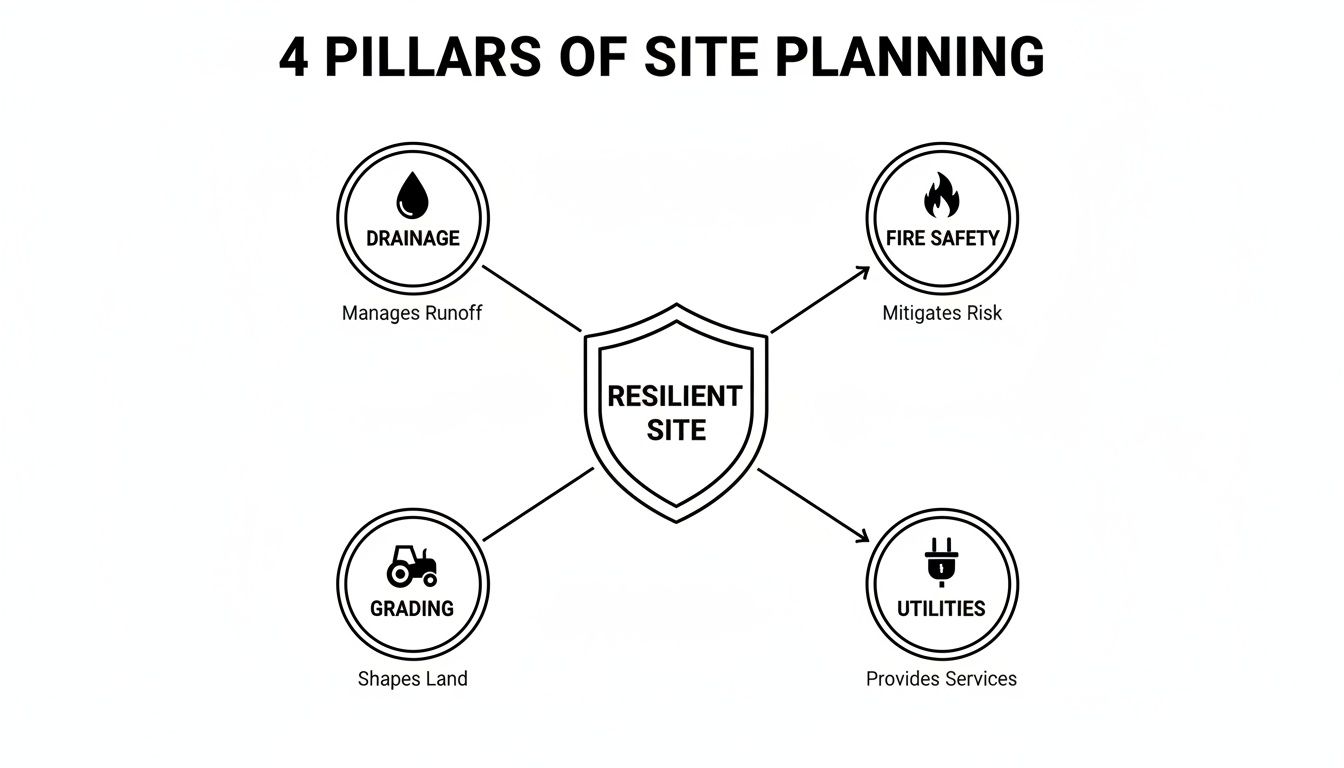
As you can see, drainage, fire safety, grading, and utilities aren't just separate tasks. They are interconnected systems that must be planned as a whole to create a site that’s truly built to last.
High-Tech Tools for On-the-Ground Precision
It’s not just about the planning phase; technology is also transforming the physical work on site. Two key innovations making a massive difference are:
- Drone Mapping: High-resolution drones can survey a property in a fraction of the time it would take a ground crew. They capture thousands of data points to create incredibly accurate topographical maps. To see how this works, you can explore methods like Modern Aerial Drone Mapping.
- GPS-Guided Grading: Our excavation equipment is directly linked to the digital site plan via GPS. The machine’s blade automatically adjusts to the precise elevation and slope specified in the design, guaranteeing sub-inch accuracy.
This level of precision isn't a luxury anymore; it's a necessity for meeting today’s strict regulatory standards. It guarantees that water flows exactly where it needs to and that your foundation rests on a perfectly prepared, stable base.
By embracing these technologies, DW Excavation delivers site plans that are optimized for long-term performance. This gives contractors and homeowners faster approvals, reduced liability, and projects built to handle California’s real-world challenges.
Your Checklist for a Future-Proof Property
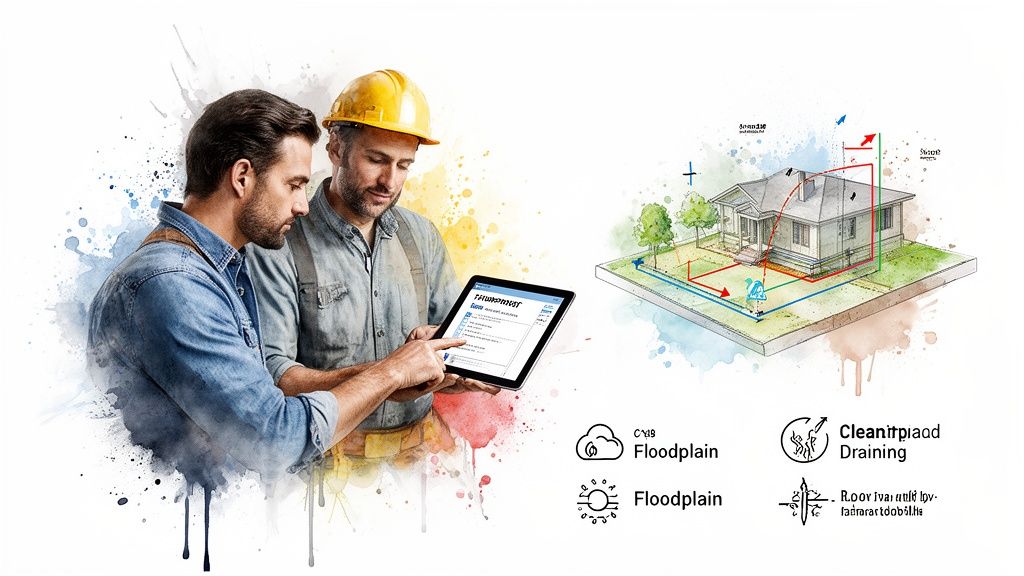
Knowing about the shift in site planning every property owner should know is a good start. Putting that knowledge to work is what really counts. Asking the right questions before breaking ground can save you from permit denials and expensive rework.
Think of this checklist as your practical guide for vetting contractors and reviewing your site plans. It’s designed to help you spot weaknesses in an outdated approach, especially in high-risk areas like Sonoma and Monterey Counties.
Site Plan and Regulatory Compliance
Before you sign off on any site plan, you need to be certain it meets all current local and state regulations. These rules have gotten much tougher in recent years.
Here’s what to ask to make sure you’re covered:
- Floodplain and Waterways: Does the plan clearly show the 100-year floodplains or any nearby seasonal creeks? How does it account for them?
- Local Code Adherence: Can your contractor point out exactly how the plan addresses the latest stormwater management and erosion control codes for your specific county?
- Permit History: Can they show you a proven track record of getting similar plans approved by your local planning department without major revisions?
Soil, Grading, and Foundation Stability
The ground beneath your structure is everything. Your entire investment rests on it, which is why proper soil analysis and precision grading are fundamental to creating a safe, durable building pad.
A rock-solid plan must address these points:
- Geotechnical Reporting: Is there a professional soil stability report (also called a geotechnical report)? This is non-negotiable for hillside properties.
- Engineered Grading: Look at the grading plan. Does it create obvious, positive drainage that moves water safely away from your foundation?
- Compaction Standards: Does the plan specify the soil compaction levels required for a stable base? You can learn more about why this is so critical in our article on what is a building pad.
A truly future-proof property starts with a site plan that respects the land it’s built on. It must proactively manage water, anticipate fire risks, and provide a stable base engineered for California's unique environmental pressures.
Fire Safety and Emergency Access
If your property is anywhere on the Central Coast or in surrounding fire-prone areas, planning for wildfire resilience is an absolute must. A smart site design can dramatically increase a home's chance of survival.
Your site plan needs to confidently answer these questions:
- Defensible Space: Are defensible space zones clearly integrated into the grading plan, as required by your local fire department?
- Access Roads: Are driveways and access roads graded to a slope and width that can support heavy emergency vehicles like fire trucks?
- Fire-Resistant Landscaping: Does the plan consider how landscaping and hardscaping can create natural fuel breaks to slow a fire’s spread?
At DW Excavation, our engineering-integrated approach is designed to navigate these modern challenges, giving you peace of mind and a superior result. It also helps to understand the truth about excavation projects most contractors don't tell you.
Frequently Asked Questions About Modern Site Planning
The world of site planning has changed dramatically, and it's completely understandable to have questions. Here are straight answers to the questions we hear most often from property owners in Sonoma and Monterey counties.
1. Why can’t I just use a site plan from a few years ago?
Regulations in counties like Sonoma and Monterey have been completely overhauled in response to recent wildfires and floods. A plan from even five years ago almost certainly fails to meet today’s strict standards for stormwater management and defensible space, making it a recipe for instant rejection.
2. Does better site planning cost more upfront?
Yes, a modern, engineering-integrated site plan often has a higher initial cost than a basic sketch. But that upfront investment is your best defense against catastrophic budget overruns, preventing expensive rework, heading off future drainage disasters, and getting your permits approved faster.
3. Is an advanced site plan really necessary for a small project like an ADU?
Absolutely. An ADU must follow the exact same rules for drainage, grading, and foundation stability as a main house. Since ADUs are often squeezed onto tricky lots, meticulous planning is even more critical to avoid creating a drainage nightmare for both buildings.
4. What is the biggest mistake property owners make with site planning?
The most common—and most expensive—mistake is hiring a contractor who is behind the times. Many still operate on outdated knowledge of new codes and climate risks, leading to plans that are dead on arrival at the permit office and trigger months of costly delays.
5. How do I know if my Central Coast property needs a special drainage plan?
Given our region's hilly terrain and intense rainstorms, it’s safer to assume every property needs a professional drainage plan. Red flags include being on any kind of slope, being near a creek, having heavy clay soil, or adding any "impervious surfaces" like a new driveway or patio.
Ready to build your next project on a foundation of certainty? The team at DW Excavation specializes in creating modern, climate-ready site plans that cut through the red tape in Sonoma County, Monterey County, and across the Central Coast.
Reach out before you break ground. We'll create a plan that’s built for today’s standards and ready for tomorrow’s challenges.