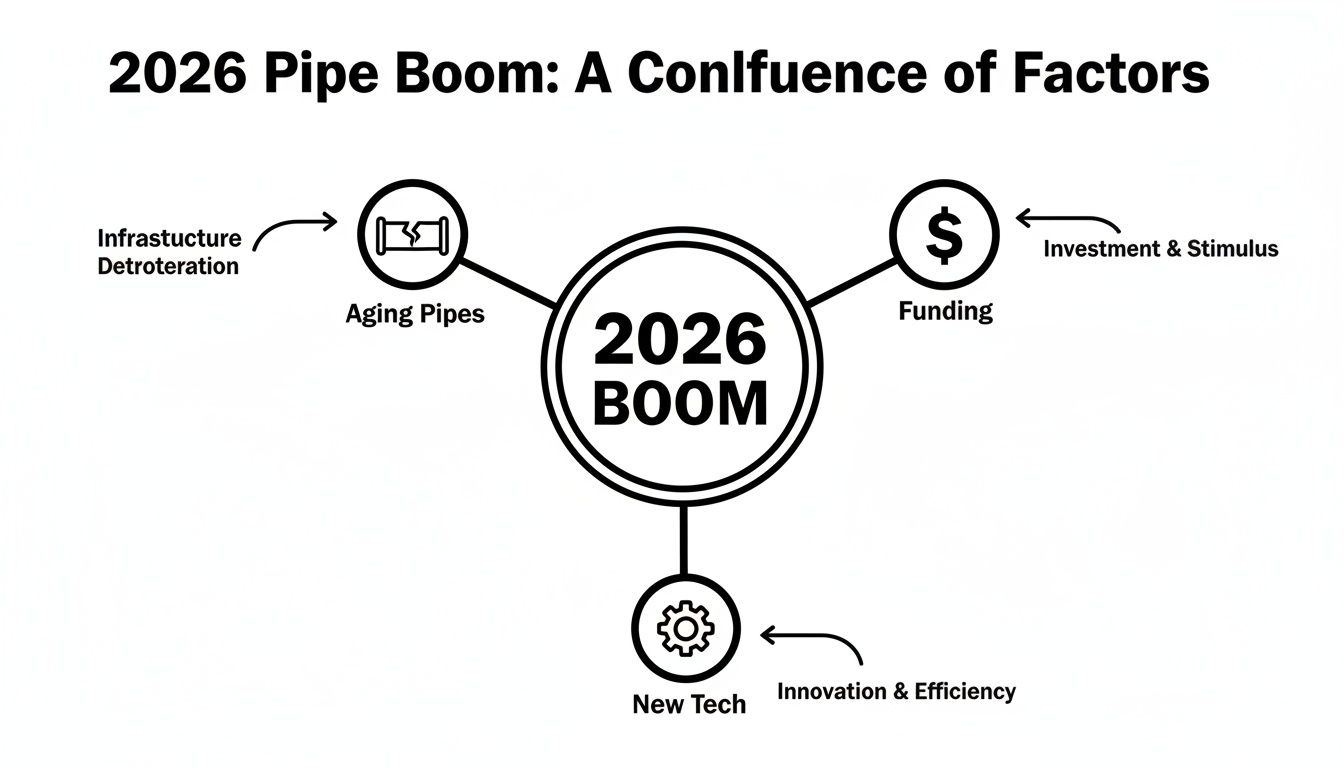
If you work in construction or municipal planning, you’ve probably noticed the ground is shifting beneath our feet—both literally and figuratively. The year 2026 is shaping up to be a breakout year for underground pipe repairs, and it's not just a hunch. It’s the result of three powerful forces converging: ancient infrastructure hitting its breaking point, a massive wave of federal funding reaching local projects, and game-changing repair technologies becoming mainstream.
For years, deferred maintenance on subterranean water and sewer lines was the norm, but that's changing. Across the California Central Coast, from Sonoma to Monterey, we're seeing a fundamental shift from reactive fixes to proactive upgrades. This isn't just another year of routine maintenance; it’s a perfect storm creating unprecedented demand.
This alignment of aging pipes, new money, and modern methods means more opportunities, but it also means contractors who aren’t prepared will miss out. Tighter deadlines and a greater need for efficient, reliable project execution are the new standard.
Three Forces Creating a Surge in Demand
This sudden spike in underground pipe repair work didn't happen overnight. It’s the result of several critical factors hitting their peak simultaneously, opening a window of opportunity for property owners and contractors.
Let’s break down the three core drivers:
- Aging Infrastructure: A huge portion of our nation's pipes were put in the ground over 50 years ago. They are well past their expected lifespan and are now failing at an alarming rate. Catastrophic breaks are no longer rare accidents; they're the predictable result of system-wide decay.
- Historic Federal Funding: A staggering $69 billion in federal funding is being allocated to upgrade these failing water systems [USA.gov, 2024]. This capital is now flowing to local municipalities, turning long-delayed plans into shovel-ready jobs.
- Advanced Technology: Modern techniques like trenchless pipe repair have finally hit their stride. They offer a faster, less disruptive, and often more affordable solution than digging massive trenches, making large-scale projects far more feasible.
This convergence is summarized in the table below, which outlines the key catalysts turning 2026 into such a critical year for our industry.
Key Factors Driving the 2026 Pipe Repair Surge
| Driving Factor | Impact on the Industry | Why It Matters in 2026 |
|---|---|---|
| Aging Infrastructure | A rapid increase in pipe failures, leaks, and water main breaks. | The sheer volume of pipes reaching the end of their service life creates a non-negotiable demand for immediate action. |
| Federal Funding Influx | Municipalities now have the capital to fund large-scale replacement and rehabilitation projects that were previously unaffordable. | The money is allocated and flowing, meaning projects planned years ago are finally getting the green light. |
| Mature Technology | Trenchless and diagnostic tools make repairs faster, less disruptive to communities, and more cost-effective. | Widespread adoption allows more projects to be completed within the funding timelines, accelerating the pace of work. |
As you can see, each factor reinforces the others, creating a powerful multiplier effect that will define the market for the next few years.
This isn't just about patching leaks anymore; it’s a strategic, nationwide shift toward upgrading entire water systems from the ground up. For contractors, understanding this dynamic is essential for winning high-value projects. Proactive water management services are key to navigating this new landscape.
How Federal Funding Is Unlocking Local Projects
The biggest reason 2026 is a breakout year for underground pipe repairs is a historic wave of federal investment. For decades, local governments kicked the can down the road on essential water infrastructure upgrades due to tight budgets. That era is officially over.
A massive $69 billion in federal funding is now flowing into state and local governments, earmarked specifically for modernizing these critical, aging systems. This isn't some far-off promise; the money is here, and 2026 is the key moment when planning phases wrap up and projects become "shovel-ready." This flood of capital is driving a major wave of underground pipe repairs across California.
From Federal Mandate to Local Impact
This financial pipeline was designed to move money from federal programs directly into community-level action. This funding is flowing fast to cities and counties, increasing demand for contractors who can deliver reliable pipe repair—especially trenchless methods that reduce surface disruption.
Municipalities along the California Central Coast, including those in Sonoma and Monterey County, are now in a position to put these funds to work. They are actively looking for reliable contractors to execute projects that were once just unfunded ideas on a wishlist, creating an immediate and direct demand for expert excavation and pipe repair services.
For contractors, this changes everything. Projects stuck in limbo for years are now green-lit priorities. This dramatically increases the need for teams who can handle not just the technical work, but also the administrative hoops that come with publicly funded jobs.
This influx of cash couldn't have come at a better time. The American Water Works Association estimates the U.S. needs to invest over $1 trillion in water infrastructure over the next 25 years [AWWA, 2023]. A huge chunk of this new funding is going toward less invasive, non-disruptive technologies.
Preparing for a Surge in Public and Private Projects
The availability of grants and subsidies isn't just for municipalities. More property owners, public works departments, and HOAs are looking for preventative upgrades instead of waiting for pipe failures. This is creating a two-pronged demand spike: large-scale public works and countless smaller, private-sector repairs.
A boom like this requires more than just skilled labor; it demands a rock-solid supply chain. Contractors need partners who can guarantee a steady flow of materials for these newly funded projects. Getting ahead of this wave means planning carefully, from sourcing aggregates to having the right team ready for grading and excavation.
You can learn more in our overview of reliable construction material supply services that keep projects on track. Getting prepared now is the key to capitalizing on the opportunities 2026 will bring.
The Technology Making Repairs Faster and Cheaper
Beyond the surge in funding, there’s another critical factor making 2026 a breakout year for underground pipe repairs: the tech has finally caught up. For decades, the only answer to a broken pipe was a massive, disruptive trench that tore up roads, landscaping, and daily life. That’s just not the reality anymore.
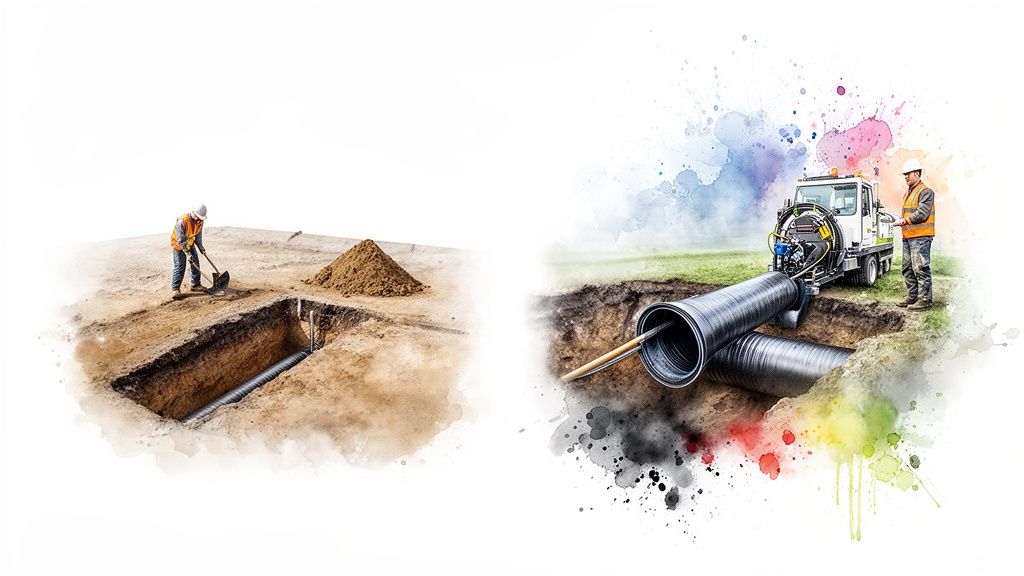
Minimally invasive methods, known as trenchless technologies, have completely changed the game. These techniques are now the go-to standard for publicly funded projects because they’re faster, often more affordable, and dramatically reduce the headache for local communities.
The Power of Trenchless Repair Methods
Think of traditional pipe repair as open-heart surgery—highly effective, but extremely invasive with a long recovery time. Trenchless methods, on the other hand, are like laparoscopic surgery. The work gets done from the inside, fixing the problem with only a couple of small incisions at the surface.
Two of the most common and effective techniques we see are:
- Cured-In-Place Pipe (CIPP) Lining: A flexible, resin-soaked liner is inserted into the damaged pipe. Once in place, it’s inflated and cured solid with heat or UV light, creating a brand-new, jointless pipe inside the old one that seals cracks and restores strength.
- Pipe Bursting: When a pipe is too damaged for relining, a machine pulls a brand-new pipe through the old one, fracturing the existing pipe outward into the surrounding soil. It’s a full replacement without the full-scale trench.
These modern solutions are a huge reason why so many more projects are getting the green light. They keep traffic flowing, preserve mature trees, and get essential services back online in a fraction of the time it used to take.
DW Excavation’s Role in Modern Repairs
While we bring in trusted partners for specialty lining, our expertise is the critical first step that makes it all possible. Even "trenchless" repairs aren't truly trenchless—they still require precise excavation to create access points. This is where our engineering-focused approach shines.
We handle all the essential site prep for open-trench and trenchless utility repair, including:
- Digging the small entry and exit pits required for the equipment.
- Ensuring the surrounding soil is stable and properly shored up.
- Coordinating with utility locators to avoid disastrous, costly mistakes.
Our careful site management sets the stage for a smooth, successful repair. It’s the same precision and know-how we bring to our septic trenching services, which gives us deep experience in the sensitive excavation needed for complex underground work.
With the trenchless pipe repair market projected to grow from $6.62 billion in 2025 to over $9.57 billion by 2032, the demand for contractors who can expertly prepare a site for these modern methods is soaring. Learn more about the market surge in trenchless repair from 360iResearch.
America's Aging Pipes Reach a Critical Breaking Point
This sudden rush to fix underground pipes isn't happening in a vacuum. It’s the sound of a ticking clock that’s been counting down for over 50 years. A huge portion of America's buried infrastructure was laid during the post-war building boom, and all those pipes are hitting the end of their design life at the exact same time.
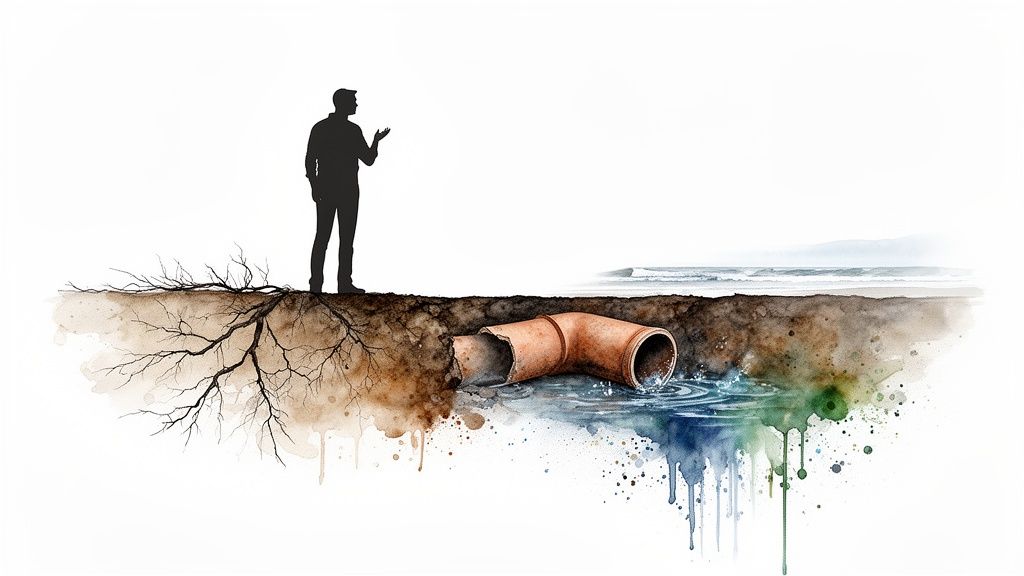
We're not just seeing a few random failures; this is a predictable wave of decay. We get the frustration property owners and public works managers feel when a massive pipe failure brings everything to a halt, flooding properties and disrupting entire communities. These emergencies are becoming far too common.
The Impact of Climate on Aging Systems
Here in California, this slow decay is being supercharged by extreme weather. The intense cycles of drought and flood that have become the norm on the Central Coast are putting immense stress on our old, fragile pipes.
- Droughts: When droughts hit, the soil shrinks and shifts, straining underground lines and causing them to crack.
- Floods: Then, the floods come, saturating the ground. This increases the external pressure on the pipes and erodes the soil that supports them.
This constant back-and-forth weakens already brittle materials like old cast iron and clay, turning what would have been a minor issue into a catastrophic break. Because of this, the entire market is shifting away from reactive emergency calls toward proactive, preventative upgrades.
A Market Shift from Reactive to Proactive
This widespread infrastructure collapse is forcing a clear shift in the market. The U.S. Sewer & Pipeline Rehabilitation industry is expected to hit an $18.4 billion market size in 2026, a huge jump after five years of nearly flat growth. You can explore the full industry report on IBISWorld for a deeper dive into these numbers.
This spike is being driven by thousands of specialized businesses responding to the overwhelming demand as old pipes finally buckle under pressure. The data confirms what we're already seeing on the ground here in Sonoma and Monterey County: property owners and municipalities simply can't afford to wait for disaster to strike anymore.
They’re now actively seeking complete system overhauls, creating a massive surge in demand for reliable underground utility services. This proactive mindset is exactly why 2026 is shaping up to be a breakout year for underground pipe repairs.
Navigating the New Landscape of Pipe Repair Projects
The game is changing for underground pipe repair, and fast. With a massive influx of funding and a serious shift toward modern repair methods, 2026 is shaping up to be a make-or-break year. Contractors who aren’t prepared to meet this demand—especially those unfamiliar with modern repair methods or permitting processes—will miss out on high-value, shovel-ready opportunities.
Sticking with the old ways of doing things just won’t cut it anymore. Municipalities are holding projects to a higher standard, demanding efficiency and minimal disruption. Outdated methods may also delay approval for public-facing jobs.
Common Pitfalls in the 2026 Market
As demand for underground pipe repairs skyrockets, a few common pitfalls can completely derail a project and tank a contractor's reputation. Most of these issues trace back to outdated approaches that create the exact kind of delays and budget overruns that public agencies and private clients have no patience for.
Here are the project-killers we see most often:
- Failed Inspections: Trying to use traditional open-trench methods in dense neighborhoods or near sensitive creeks can lead to an immediate inspection failure. Municipalities across Sonoma and Monterey Counties are increasingly favoring—and in some cases, mandating—less disruptive solutions.
- Permitting Delays: Every county has its own thicket of codes, especially for projects using public funds. Not knowing that red tape inside and out can stall a project for weeks or months before a single shovel hits the ground.
- Community Disruption: Nothing sours a project faster than tearing up a whole street or a carefully landscaped common area. The resulting complaints from frustrated property owners and HOAs can lead to work stoppages and make it harder to land the next job.
The challenge today isn’t just about digging a trench. It's about executing a project that meets modern engineering standards, sails through local inspections, and keeps the community happy. Sticking to old habits has become a serious business risk.
Your Expert Partner for Site Prep and Coordination
This is where a strategic partner makes all the difference. DW Excavation understands the pipeline funding surge and is equipped to support open-trench and trenchless utility repair prep. We handle the complex site preparation and coordination that’s essential for a smooth project.
We don’t just dig. We handle grading, access excavation, and permitting—helping general contractors deliver compliant, on-time results. Partnering with DW Excavation means fewer delays, greater flexibility, and better coordination with municipalities—so contractors can focus on execution, not red tape.
If you’re taking on infrastructure upgrades in Sonoma or Monterey County, DW Excavation is the partner who knows the codes, the funding flow, and the field conditions. Tap into our trenching expertise while this federal window is open.
How to Prepare Your Business for the 2026 Surge
Anyone with boots on the ground can feel it coming. The combination of our region's aging pipes, a massive injection of federal funding, and the maturity of trenchless technology is creating a perfect storm. We believe 2026 is going to be a breakout year for underground pipe repairs.
For contractors and public works departments on the Central Coast, this isn't just a forecast—it's a wave of opportunity headed straight for us. But catching that wave depends entirely on being ready for a new way of doing things and partnering with the right people.
More demand means tighter schedules, sharper municipal oversight, and zero patience for delays caused by old-school methods. Success in 2026 is all about having a smart, strategic game plan.
Your Strategic Partner on the Central Coast
At DW Excavation, we're not just another name on a subcontractor list. We are a strategic partner, ready to help you capitalize on this surge. We de-risk these complex projects by expertly handling the critical groundwork that sets the stage for efficient, compliant, and profitable repairs.
Our core services are built to solve the exact challenges this new market presents:
- Access Excavation: We create the precise, stable entry and exit pits that modern trenchless repair equipment absolutely requires to function correctly.
- Site Grading: Our engineering-minded approach ensures the site has proper drainage and long-term stability, so you aren't creating a new problem while fixing an old one.
- Permit Navigation: We know the local codes and what inspectors in our communities look for, helping your projects slice through red tape and get approvals the first time.
With the right support system, this boom in underground pipe work is a massive opportunity, not a logistical nightmare. It all comes down to having a partner who makes sure the entire job—not just the dig—is ready for inspection and long-term performance.
When we handle the crucial site prep and coordination, it frees you up to do what you do best: execute the repair. If you're getting ready for the wave of projects coming to the California Central Coast, finding the best underground pipe repair contractor starts with locking in an expert excavation team. Let DW Excavation be your trusted partner in turning the challenges of 2026 into your biggest opportunities.
FAQs About the 2026 Pipe Repair Boom
What’s the biggest advantage of trenchless pipe repair in Sonoma County?
The single biggest benefit is minimal disruption. In dense neighborhoods or on properties with mature landscaping, digging massive trenches is a nightmare. Trenchless methods get the job done without all that destruction, which means projects wrap up faster, restoration costs are lower, and the community stays happy.
How can my project qualify for federal infrastructure funding?
The best first step is to get in touch with your city or county's public works department. They will have the most current information on available grants and local priorities. As your site prep partner, DW Excavation helps ensure your project’s site plan aligns with the requirements to give you the best shot at securing that capital.
Does DW Excavation perform the actual pipe lining?
Our expertise is in all the critical work that happens before the new pipe goes in—the precision excavation, site access planning, and expert grading. For the CIPP lining or pipe bursting itself, we bring in our trusted, specialized partners. This approach gives you best-in-class experts for every single phase of the job.
Why is an engineering-integrated approach so important for site prep?
An engineering-integrated approach means the excavation plan is built to support the technical needs of the repair and account for local geology. It ensures grading is perfect for long-term stability and that the entire project flies through municipal inspections in places like Monterey County, preventing costly mistakes before they happen.
What is the first step to prepare for a trenchless repair project?
Everything starts with a thorough site assessment. This involves locating all existing utilities, evaluating soil conditions, and mapping out the precise access points for the trenchless equipment. Proper site planning is the real foundation for an efficient and successful repair.
Ready to tackle the opportunities of 2026 with an expert partner? DW Excavation, LLC has the local knowledge and technical skill to ensure your next underground pipe repair project is set up for success from day one. Contact us to discuss your project needs.