Here’s a hard truth: the first bid you get for an excavation project rarely tells the whole story. Many contractors focus on the simple task of moving dirt, often glossing over the messy, expensive surprises that can emerge once the digging starts.
What looks like a straightforward quote is often just the tip of the iceberg, hiding the real financial risks that lurk underground. We're here to uncover what most contractors don’t tell you about excavation projects.
Why Do Excavation Projects Really Go Over Budget?
Staring at that initial bid can feel reassuring, but the real reasons projects go off the rails are almost always buried—literally. It’s not just about digging a hole; it’s about navigating the unseen challenges that can turn a predictable job into a budget-breaking nightmare.
Some contractors might downplay these risks to offer a lower, more attractive price upfront. While it creates a false sense of security, that strategy often backfires when reality hits, leading to frustrating delays and unexpected costs.
The Real Cost of "Unforeseen" Issues
The moment work stops because the crew hits unstable soil or a hidden groundwater spring, the meter starts running. That’s when you get the dreaded change order—a bill for thousands to fix a problem that a contractor claims they “couldn’t have predicted.” The truth is, these are precisely the kinds of risks an engineering-minded expert would have planned for.
This isn’t just a rare hiccup; it's a huge problem in construction. According to the Project Management Institute, nearly 35% of construction projects experience budget overruns, with poor planning cited as a major cause [PMI, 2021].
These overruns are often preventable. They happen when there’s a massive disconnect between the blueprint and the actual ground conditions. A basic grading plan might look fine on paper but completely ignore how the expansive clay soils in Sonoma County will swell with moisture, leading to foundation cracks down the road. You can get a better sense of these underground complexities in our guide on underground utility services.
What Contractors Say vs. The Engineering Reality
| The Common Contractor Pitch | The Untold Engineering Truth |
|---|---|
| "We'll handle any surprises as they come up." | "Unplanned 'surprises' mean expensive change orders and major delays. A proper geotechnical report and site analysis should have identified these risks upfront." |
| "This is a standard dig; your soil looks fine." | "Visual inspection is not enough. Soil composition, moisture content, and compaction ratings are critical engineering data points that dictate the entire project's stability." |
| "We don't need a full utility survey; we'll call 811." | "811 only locates public utilities. Private lines for wells, septic systems, or secondary buildings are often unmapped and are a huge financial risk if struck." |
| "We'll grade it to match the plans." | "The plans are just a starting point. True grading requires understanding drainage, soil swell potential, and long-term erosion to protect the final structure." |
Thinking like an engineer from day one is the key. It’s about turning unknown variables into manageable, predictable parts of the plan. This proactive mindset is what separates a standard digging crew from a true partner who’s focused on protecting your investment.
Decoding Your Site's Biggest Risk: Soil and Water
The ground beneath your project holds the biggest—and often most expensive—secrets that can make or break your budget. Most contractors focus on what they can see, like the size of a foundation or the length of a trench.
But the real financial risks are hiding in the soil and water they often fail to properly investigate. This is where catastrophic budget overruns are born.
Why a Shovel Test Isn't Enough
A common shortcut is a quick visual inspection or a basic "shovel test." A contractor might dig a small hole, grab a handful of dirt, and declare it "good enough." This is one of the hard truths most contractors won't tell you: that level of analysis is dangerously inadequate, especially in a place like the California Central Coast.
Expansive clay soils, common in areas like Sonoma County, act like a sponge, swelling when wet and shrinking when dry. A foundation poured on improperly prepared clay will be lifted and dropped with the seasons, leading to severe cracks and expensive repairs. This is exactly how a project's budget gets blown apart.
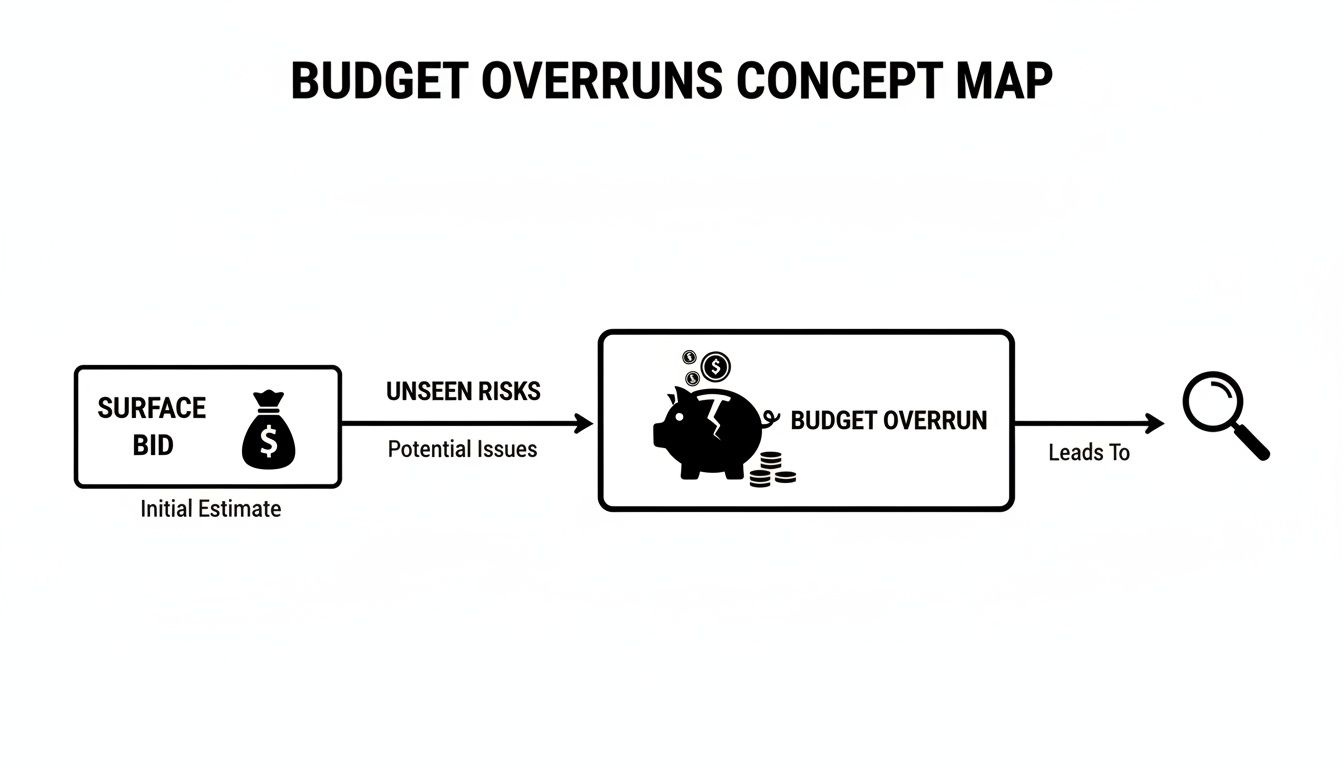
There’s a direct line from an attractive initial bid to the budget-shattering reality of fixing problems that should have been found from the start.
The Problem With Hidden Water
Just as critical as the soil is groundwater. An undiscovered perched water table—a hidden pocket of groundwater—can turn a straightforward dig into a muddy, unstable mess. Suddenly, your project needs expensive dewatering systems and specialized backfill material, none of which were in the initial quote.
These aren't rare "surprises." They are predictable variables that demand an engineering-led approach to find and solve ahead of time. A proper geotechnical investigation gives you the data needed to design a stable, durable site from the ground up.
An engineering-first mindset transforms the underground from a financial gamble into a calculated part of the project plan. It accounts for soil mechanics and hydrology to ensure the foundation you build on today remains stable for decades to come. Explore our engineering-based water management services to see how we tackle these challenges head-on.
Navigating The Maze of Permits and Regulations
Permitting is one of the most common—and frustrating—bottlenecks in any construction project. Contractors often say they'll "pull a permit," treating it like a simple item on a to-do list.
That thinking is a dangerous oversimplification. The truth is, getting a plan approved is a full-blown navigation of local codes, environmental laws, and engineering standards that are constantly evolving.
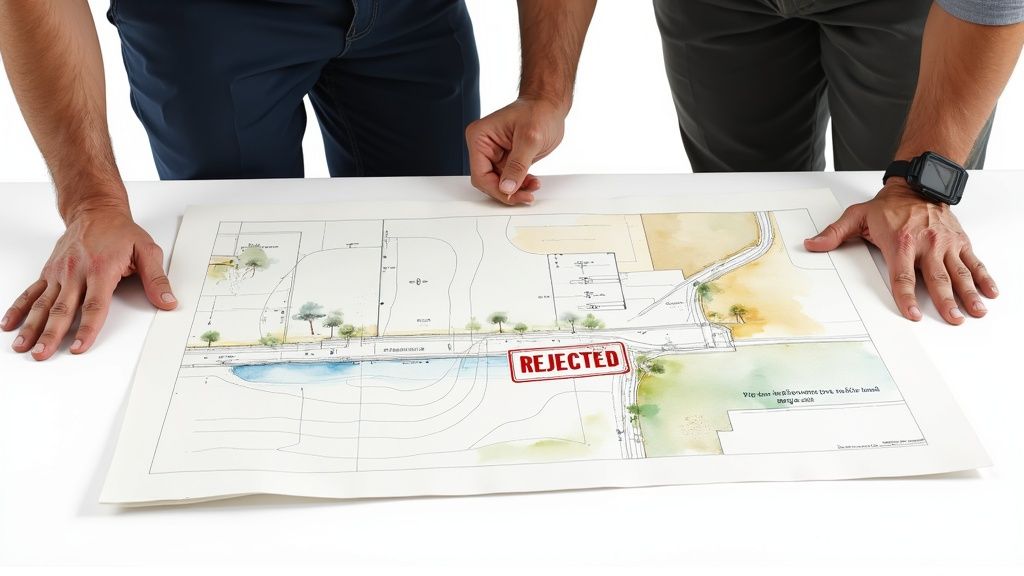
A site plan that sailed through the approval process last year might get flat-out rejected today. When that happens, your project grinds to a halt for weeks—or even months—while you scramble to fix the design.
Why Do Standard Plans Get Rejected?
City and county inspectors are on the front lines, tasked with enforcing a dense and growing list of regulations. This is especially true here in California, where codes are continuously updated.
For instance, in 2024, many counties, including parts of Sonoma and Monterey, updated codes to require more sophisticated on-site stormwater retention. A basic grading plan that just pushes water off the property is now an instant failure.
Today, inspectors scrutinize plans for a deeper level of detail:
- Stormwater Management: Does your plan feature engineered solutions like bioswales or retention basins?
- Erosion Control: Are there specific measures to stop soil from washing into public waterways?
- Environmental Compliance: Does the project respect protected habitats or address local soil stability?
If a plan comes up short, it gets a rejection stamp, and your timeline is blown.
The Engineering-First Advantage for Approvals
An engineering-first approach makes all the difference. Instead of just mapping out how to move dirt, we design a complete system built to satisfy regulatory demands from the start.
We integrate drainage, soil stability, and environmental compliance directly into the core excavation strategy. A shovel-ready plan is useless if it's not also an approval-ready plan. This proactive method is the only real answer to the question, "what is a site plan and who can help me make one?"
Common Permitting Pitfalls in Excavation
| Common Contractor Oversight | Potential Consequence | Engineering-Integrated Solution |
| :— | :— |
| Generic grading plan | Plan rejection for failing to meet new stormwater codes. | Design of on-site retention and drainage systems that comply with local regulations. |
| Ignoring soil reports | Work stoppage after inspectors find inadequate foundation support. | Geotechnical data is used to engineer stable pads and footings that meet code. |
| Vague erosion control notes | Fines and delays for non-compliance with environmental protection rules. | A detailed erosion and sediment control plan is integrated into the site plan from day one. |
Navigating the permitting maze isn't about luck. It's about submitting a plan so thorough, compliant, and well-engineered that it leaves zero room for questions or rejection.
The Hidden Costs of Poor Site Coordination
A successful excavation project is a masterclass in coordination. Here's a truth most contractors won't tell you: digging doesn't happen in a vacuum. It’s the critical first step that every other trade—from plumbers to the foundation crew—depends on.
When that first step is misaligned, the entire project stumbles. A simple communication breakdown can lead to footings being poured in the wrong place. Correcting this means breaking up freshly poured concrete, re-digging, and starting over—burning both time and money.
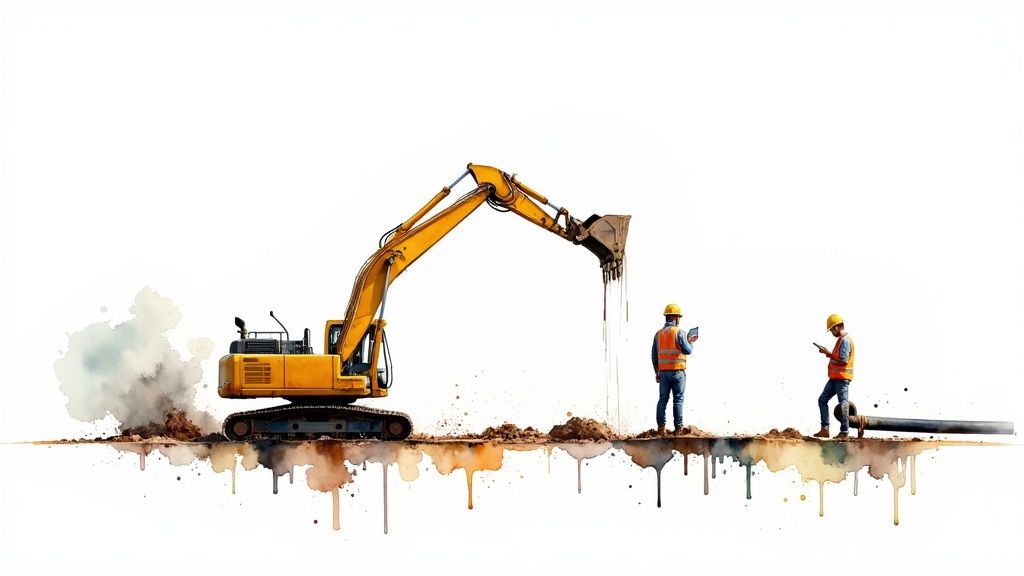
What Happens When You Strike a Utility Line?
One of the most dangerous coordination failures is a utility strike. Hitting a water main can flood your site, while striking a gas line creates a public safety hazard. Even severing a fiber optic cable can result in thousands of dollars in repair costs and liability.
This risk is amplified with modern trenchless technology, a market now valued at over $6 billion [MarketsandMarkets, 2023]. Trenchless methods demand surgical precision. Without an engineering-grade understanding of every underground utility, the risk of a catastrophic strike increases dramatically.
How Communication Breakdowns Cost a Fortune
Poor coordination leads to a cascade of problems that drive up costs and push back deadlines. It's a systemic issue that plagues the entire construction industry.
Research shows that poor communication is a leading factor in project failure, costing businesses billions annually due to rework and delays [FMI Corporation, 2018]. These statistics reveal a critical truth: project success hinges on seamless integration. Our reliable construction material supply services integrated into the workflow is a game-changer for project timelines.
The Engineering-Led Coordination Advantage
An engineering-led process acts as the project’s central command. It isn't just about digging a hole; it’s about ensuring that hole is perfectly synchronized with the master plan.
An engineer-driven approach guarantees that:
- Utility Lines Are Mapped: All utilities are precisely located and integrated into the site plan.
- Elevations Are Perfect: Every grade and slope is cut to exact engineering specifications.
- Timelines Are Synchronized: Excavation work is scheduled in lockstep with other trades.
Contractors in Sonoma and Monterey Counties understand that site conditions are rarely simple. By integrating excavation with engineering, you avoid the change orders and mid-project redesigns that derail so many projects.
When "Years of Experience" Just Isn't Enough
We've all heard it: a contractor proudly states they have "30 years of experience." While hands-on skill is vital, relying on old-school methods alone is a huge liability in today's complex construction environment.
The uncomfortable truth is that experience can't see underground. A seasoned operator knows their machine, but pure instinct can't tell you a soil's load-bearing capacity or predict how groundwater will behave under a new foundation.
The Real Crisis: A Widening Skills Gap
The construction industry faces a significant skills shortage. Many crews are unprepared for the technical side of modern building, from new materials and ever-changing codes to complex systems like trenchless utilities.
This gap is a direct line to project failure. A global survey found that a lack of skilled talent is a top cause of project underperformance, contributing to significant budget and schedule overruns [KPMG, 2021]. This means organizations are losing money because teams lack the right technical know-how.
The takeaway is clear: without the right mix of technical and practical skills, even the most "experienced" teams are set up for failure from day one.
Marrying Field Expertise with Engineering Smarts
The solution isn’t ditching experience; it’s pairing it with rigorous engineering principles. The best results come from a team that combines decades of in-the-field wisdom with a deep understanding of the science behind the work. This integrated approach creates a team that can solve problems with data, not just intuition.
When you hit unexpected unstable soil, an engineering-led team doesn't guess. They analyze, recalculate loads, and implement a fix that keeps the project stable, compliant, and on schedule.
This is what solves the core reasons projects go off the rails. It ensures every move is backed by a solid grasp of soil mechanics, hydrology, and structural engineering. For anyone building in Sonoma or Monterey Counties, this blend of skills is a must-have.
A Smart Checklist for Vetting Your Excavation Contractor
Knowing the right questions to ask is the single most powerful tool you have to protect your investment. A typical contractor might give you vague assurances, but a true partner will provide concrete, data-backed answers.
Use this checklist to see past the sales pitch and find a contractor who plans for success from day one. Their answers will reveal the truth about their approach to excavation projects and whether they’re truly equipped to handle your site's unique challenges.
Questions About Site Conditions and Planning
-
"What specific risks do you see with the soil and groundwater on my property?"
- A weak answer sounds like: "We'll handle whatever comes up."
- A strong answer sounds like: "Based on the geotechnical report and local soil maps for Sonoma County, we need to plan for expansive clay. That means we’ll need to factor in moisture conditioning and potentially bring in engineered fill to guarantee long-term foundation stability."
-
"How will your grading and drainage plan comply with current local stormwater regulations?"
- A weak answer sounds like: "We'll grade it so water runs away from the house."
- A strong answer sounds like: "Our plan incorporates an on-site bioswale and retention basin, which are now required by the new 2024 county codes to manage stormwater. We can walk you through the calculations that prove our design is fully compliant."
Questions About Process and Contingencies
A detailed bid is important, but what’s more critical is understanding how a contractor handles the unexpected. This is where you separate the real planners from the improvisers.
The most expensive part of any project is the work that has to be redone. Asking about contingencies isn't about expecting problems—it's about ensuring your contractor has a clear process to solve them efficiently.
Here are the key process-related questions to ask:
- "What specific contingencies are built into your bid for unforeseen conditions like rock or unsuitable soil?"
- "Can you explain your process for coordinating with other trades, like plumbers and foundation crews, to prevent conflicts?"
- "How do you verify the location of both public and private underground utilities before digging begins?"
For more guidance, our complete guide on choosing the right excavating contractor for your project offers additional insights. This proactive vetting ensures you hire a partner who brings engineering-savvy solutions, not just a shovel.
Frequently Asked Questions About Excavation Projects
1. What is the most common hidden cost in an excavation project?
The biggest surprise is hitting unsuitable soil or unexpected groundwater. Your standard bid probably doesn't cover the high cost of soil remediation, dewatering, or trucking in engineered fill, which can easily add tens of thousands of dollars to your project. An engineering-led contractor insists on a proper geotechnical investigation upfront to transform a potential budget-killer into a known variable.
2. How can I be sure my project complies with new California drainage laws?
To meet today's strict codes, especially in places like Sonoma and Monterey County, your design must include specific stormwater management features like bioswales or retention basins. Ask your contractor to show you exactly where these features are on the site plan and explain the calculations proving their design meets local requirements before work begins.
3. My contractor hit a utility line—who is responsible?
Legally, the contractor is usually on the hook for repairs if they failed to call 811 or were negligent. But here's the reality: proving fault can turn into a messy legal fight that brings your project to a screeching halt. A true professional has a documented process for utility location to ensure a strike never happens in the first place.
4. Why is an engineering-integrated approach better than just hiring an experienced operator?
An experienced operator is fantastic at running the machinery—they know the how. But an engineering-integrated firm understands the why. This deeper expertise in soil mechanics and hydrology allows us to design a site that’s not just built, but built to last, and adapt intelligently when unexpected conditions arise.
5. What should I look for in an excavation contract to protect myself?
Look for a detailed scope of work that clearly explains the process for handling unforeseen conditions, like hitting rock or poor soil. The contract needs to spell out exactly what's included in the base price and what would trigger a change order. A transparent, detailed contract is the first sign you've found a trustworthy partner.
Ready to partner with an excavation team that brings engineering precision to every project? For contractors in Sonoma and Monterey Counties who need site work that accounts for real-world conditions and evolving codes, DW Excavation, LLC is your smarter, engineering-savvy partner. Let’s talk before you dig. Learn more at https://dw-excavation.com.